Bitcoin Hashrate Is Up 20%. Is the Mining Bear Market Over?
Published 2 days ago • 5 min read
Bitcoin is approaching one of its longest periods of negative year-over-year performance but beneath the weak price comparison, the mining network is accelerating again. Hashrate has rebounded nearly 20% from its summer low, pushing difficulty higher and erasing much of miners’ recent margin relief. At the same time, Binance is closing its mining pool after losing most of its market share, forcing its remaining miners to find a new home. Are we at the end of the mining downturn?
Difficulty Rises for the Third Time in Four Adjustments
Hashprice and Hashvalue Pushed Lower
Binance Pool Exits After Losing Market Share
FBOX’s modular architecture supports phased expansion through standardized cooling, power, and IT modules, providing a consistent framework for AI infrastructure to grow from initial deployments to campus-scale developments. A consistent system architecture enables repeatable deployment and capacity growth while reducing the need for major infrastructure reconfiguration as deployments expand.
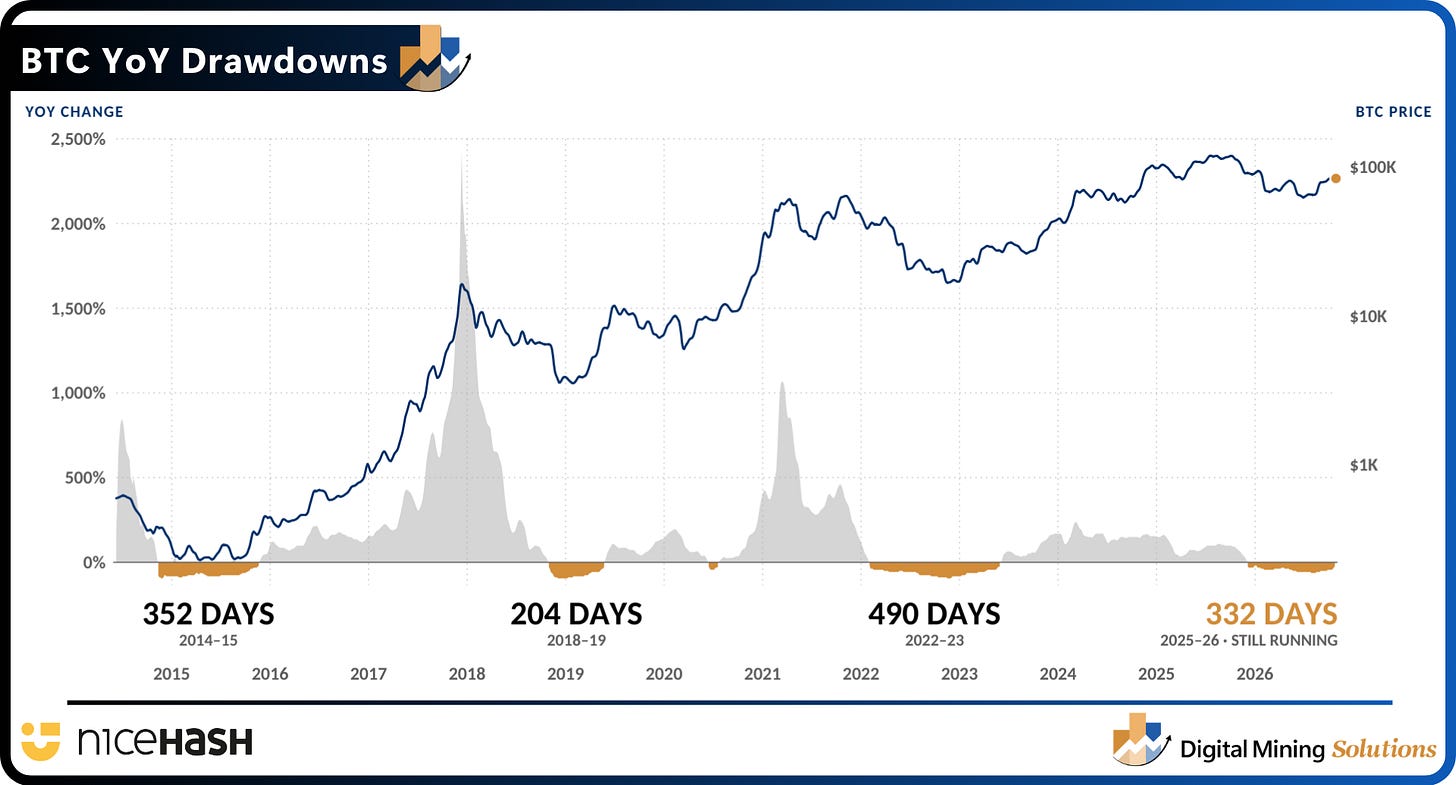
Bitcoin has now spent 332 consecutive days trading below its price from one year earlier, highlighting the persistence of the current market downturn. Historically, comparable periods of negative year-over-year performance have lasted 352, 204, and 490 days, placing the current streak among Bitcoin’s longest.
Source Look Into Bitcoin
The data highlights November 6 as a potentially important date. On that day, Bitcoin would need to trade above approximately $101,000 to turn its year-over-year performance positive. However, this is not a fixed price target. The required level changes daily because Bitcoin’s current price is compared with its price exactly one year earlier. Consequently, the negative streak could end sooner if Bitcoin appreciates sufficiently, or later at a lower price if the historical comparison becomes less demanding.
Year-over-year performance provides a broader perspective on Bitcoin’s market cycle by filtering out short-term volatility. A return to positive year-over-year performance could represent an important psychological turning point. It would signal improving price momentum, potentially strengthen investor confidence, and encourage renewed institutional and retail interest.
However, historical comparisons also provide perspective. Previous negative streaks have lasted as long as 490 days, demonstrating that prolonged periods of weak annual performance are not unprecedented. Furthermore, a return to positive year-over-year performance does not necessarily confirm the beginning of a sustained bull market, particularly if the change is primarily driven by a declining historical comparison price rather than strong current demand.
The key question is whether Bitcoin can sustain its recovery sufficiently to break the negative year-over-year trend. While turning positive would be an encouraging development, sustained demand and continued price appreciation would be more meaningful indicators of a durable market recovery.
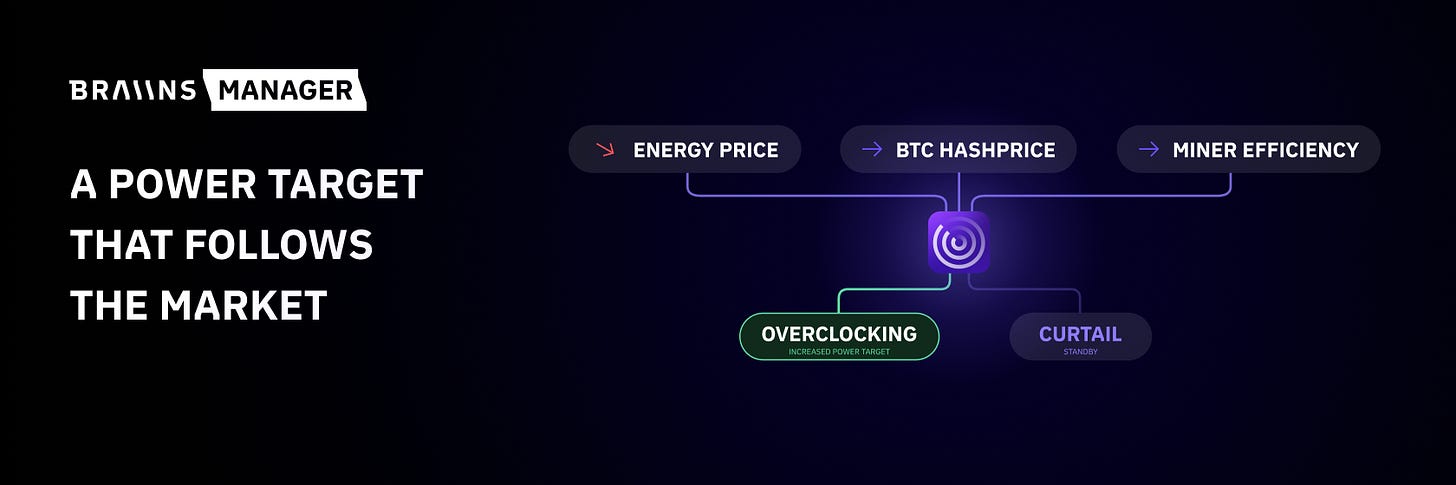
🚀 A Power Target That Follows The Market
Price Adapt is the profitability engine inside Braiins Manager, the fleet platform from the Braiins team. It weighs each miner’s efficiency against the current energy price and hashprice.
Then it applies the most profitable power target to that machine, one by one, without you touching a setting.
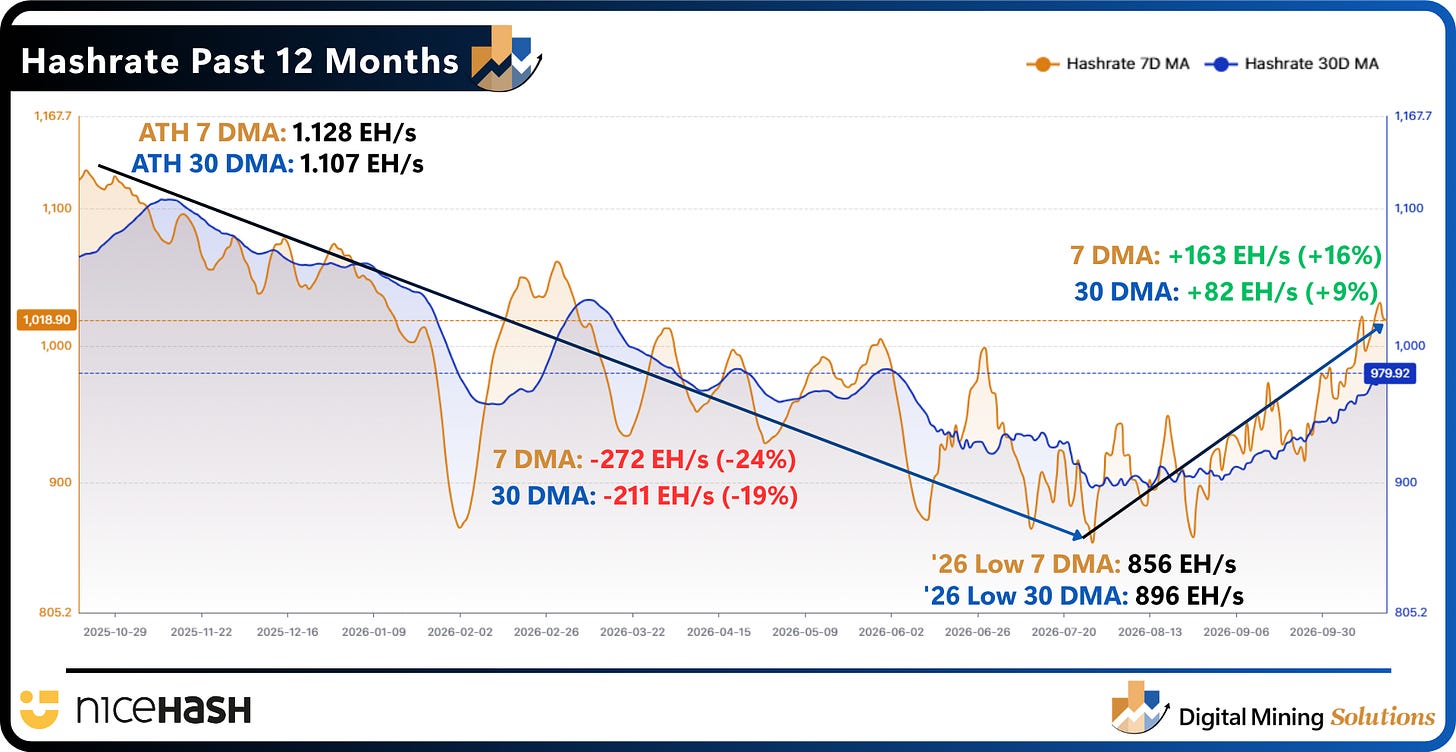
About a year after printing its ATH, the seven-day moving average has recovered above 1 ZH/s, while the 30-day average is also closing in. The seven-day average is more responsive to recent changes; it reached an all-time high of approximately 1,128 EH/s in late October 2025 before falling to a 2026 low of roughly 856 EH/s in late July. That represented a decline of 272 EH/s, or 24%.
It has since recovered to approximately 1,019 EH/s. That is an increase of 163 EH/s—or roughly 19% measured from the July low, although it remains about 10% below its previous record.
The 30-day average provides a clearer view of structural capacity. It declined from an all-time high of approximately 1,107 EH/s to a 2026 low of 896 EH/s, a 19% contraction. It has now recovered by approximately 82 EH/s to 980 EH/s, an increase of around 9%. The fact that the seven-day average is above the 30-day average indicates that the recovery has accelerated recently.
Source: Lincoin Lens
Several factors appear to be driving the rebound.
The end of the North American summer reduced temperature-related curtailment and ERCOT Four Coincident Peak exposure, allowing miners to restore uptime. At the same time, Bitcoin’s price recovery improved hashprice enough for some marginal capacity to return.
Newer machines also continued entering the network throughout the downturn. For example, Bitdeer has been deploying its internally manufactured SEALMINER fleet. Smaller operators including Ionic Digital Inc. and PowerCompute have also been replacing older machines with more efficient hardware using existing electrical infrastructure.
The recovery therefore appears to combine seasonal reactivation, improved economics and continued ASIC deployment. Not all of this capacity is genuinely new: some machines were already installed but curtailed or temporarily uneconomic. The strengthening 30-day average suggests this is more than a short period of recovery.
Difficulty Rises for the Third Time in Four Adjustments
The hashrate recovery is feeding directly into mining difficulty. The October 16 adjustment led to an increase in difficulty by 5.92%, from 132.72T to roughly 140.58T.
The recent sequence post summer is clearly reflecting the rebound of network hashrate:
September 5: +1.31%
September 19: +4.16%
October 3: −0.03%
October 16: +5.92%
The October 3 reduction technically breaks an upward streak. However, at only 0.03%, it was the smallest adjustment since 2020 and provided no meaningful economic relief. Difficulty has increased materially three times within four adjustments, with the remaining adjustment effectively flat.
Hashprice and Hashvalue Pushed Lower
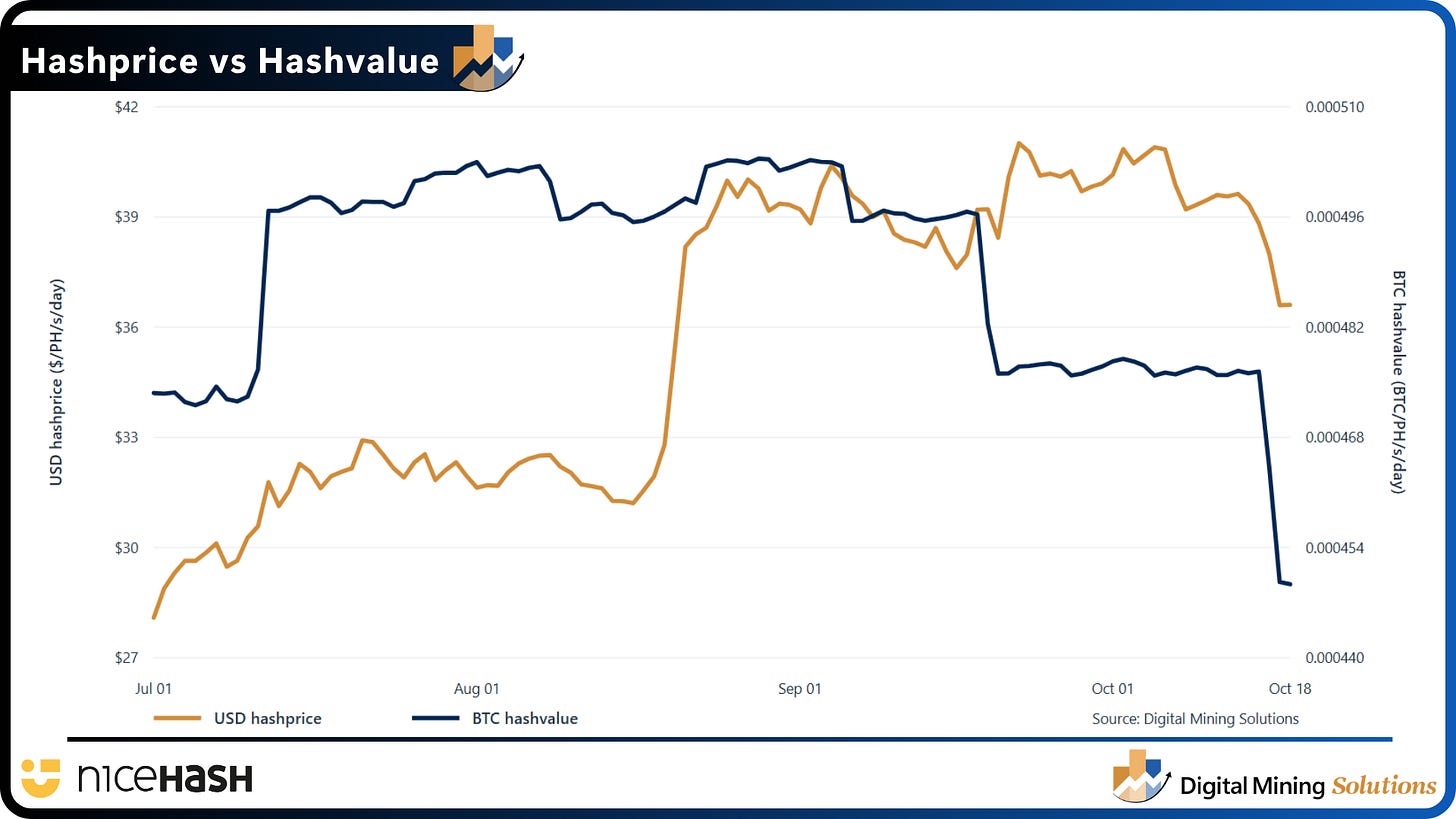
Difficulty still remains around 10% below its October 2025 record of 155.97T. But for miners’ revenue, the direction matters more than the record comparison. The latest difficulty adjustment quickly absorbed part of the improvement in mining economics. Between October 15 and October 18, Bitcoin-denominated hashvalue declined from 0.00047638 BTC to 0.00044934 BTC/PH/day. Over the same period, USD hashprice fell from $38.83 to $36.61/PH/day.
Source: Digital Mining Solutions
This reversed much of the recent margin relief. USD hashprice had briefly exceeded $40/PH/day in early October but is now approximately 10.5% below its October 5 monthly high of $40.90.
That is the uncomfortable side of the hashrate recovery. More machines are returning to the network, but unless Bitcoin’s price or transaction-fee revenue rises fast enough to compensate, each petahash earns less. The network may be recovering, while the economics of the individual miner remain under pressure.
Binance Pool Exits After Losing Market Share
Binance will close its mining pool and related services on November 10 at 07:00 UTC, ending an operation launched in April 2020. The shutdown includes Binance Pool, Pool Savings, Cloud Mining and its Transaction Accelerator.
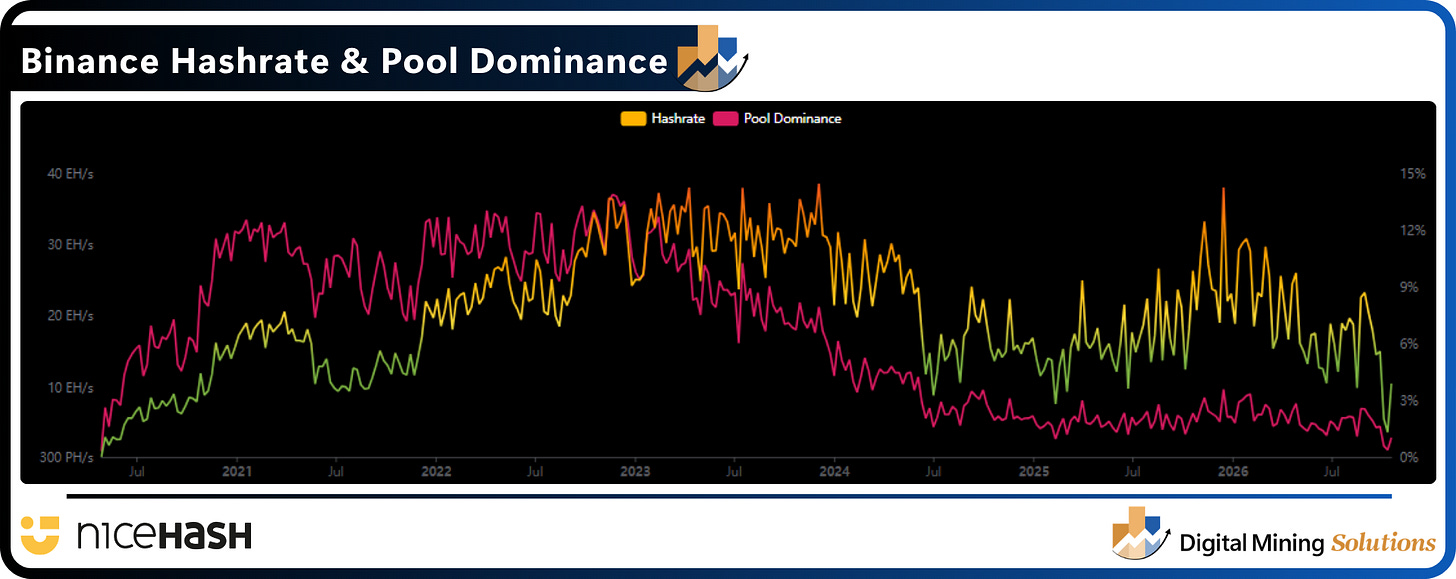
The decision follows a sustained decline in Binance’s share of Bitcoin block production. Binance Pool peaked at approximately 13% of blocks in November 2022, but its share declined to 5.9% by December 2023 and 2.1% one year later. In July 2026, Binance produced only 78 of 4,341 Bitcoin blocks, equivalent to approximately 1.8%.
The pool’s nominal hashrate peaked at the end of 2023 with 38.6 EH/s after which is started sliding. There was a short revival revisiting the same amount of hashrate at the end of 2025. But in 2026 hashrate declined all the way below 10 EH/s.
Source: Mempool.space
Miners using the pool must redirect their machines before the shutdown. Binance has warned that shares submitted after the cutoff will not be credited. Eligible balances, rewards and refunds will be processed according to its product rules and compliance requirements, while historical records will remain available until November 24.
The closure is notable because Binance originally positioned mining as an extension of its broader financial ecosystem. The pool connected miners with trading, lending, staking and other exchange services.
Binance’s exit will redistribute its remaining hashrate, but at less than 2% of block production, it should have limited effect on network operation. The larger question is whether miners migrate toward the largest established pools, increasing concentration further, or toward smaller alternatives offering better economics and service.
Is Your Mining Site Ready for AI/HPC?
Download our practical 30-minute guide for mining and infrastructure operators evaluating an AI/HPC pivot.
Learn how to assess your site’s readiness, evaluate the economics, select the right business model, and understand what institutional capital expects so you can reach a clear go/no-go decision before committing capital.