Bitcoin returned to an eight-month high as ETF inflows accelerated, but miners captured only a part of the rally. A short-term hashrate peak pushed difficulty higher, leaving hashprice stuck near $40/PH/day. Despite margins still being under pressure, PowerCompute announced they add 11.8% more hashrate without adding power. This case shows how smaller operators can still improve their position. Meanwhile, new rules in Texas are raising the cost of securing future power, turning queue positions from inexpensive options into multimillion-dollar capital commitments.
Bitcoin Returns to an Eight-Month High
ETF Flows Provided Real Support
Short Term Hashrate Peak Pushed Difficulty Higher
Hashprice Recovered, but Margin Relief Remains Limited
PowerCompute Adds Hashrate Without Adding Power
A Texas Queue Position Now Requires Real Risk Capital - Premium
FBOX’s modular architecture supports phased expansion through standardized cooling, power, and IT modules, providing a consistent framework for AI infrastructure to grow from initial deployments to campus-scale developments. A consistent system architecture enables repeatable deployment and capacity growth while reducing the need for major infrastructure reconfiguration as deployments expand.
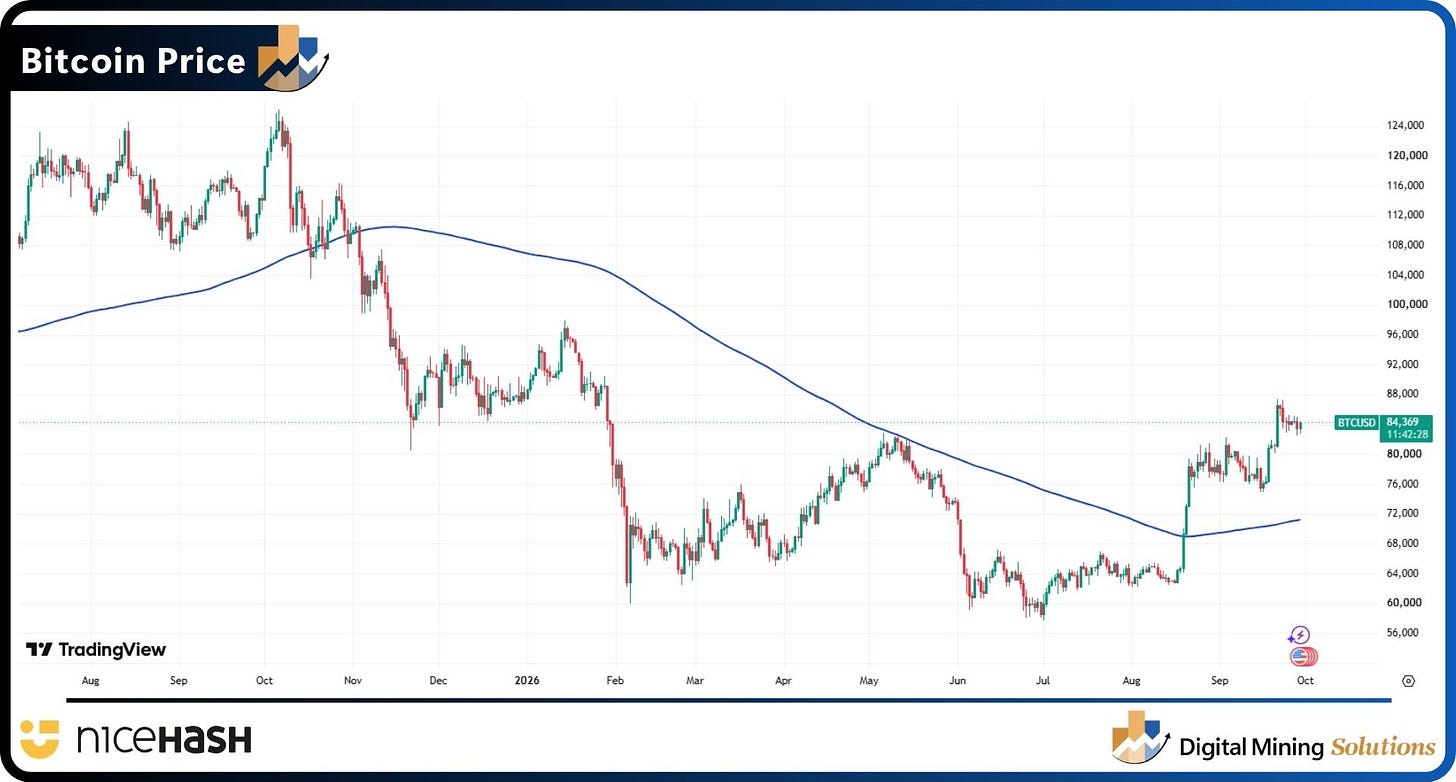
Last week Bitcoin climbed above $87,000, its highest level since January. Bitcoin moved alongside a broader return of risk appetite. Technology and semiconductor stocks rallied, and the Nasdaq approached record territory.
Source: TradingView
A short squeeze helped accelerate the move. Estimates suggest that roughly $450–$557 million of Bitcoin short positions were liquidated during the rally. This short covering can amplify a price move, but it cannot sustain it indefinitely. The more important question is whether new capital is entering the market behind the rally. For now, the ETF data suggests that it is.
ETF Flows Provided Real Support
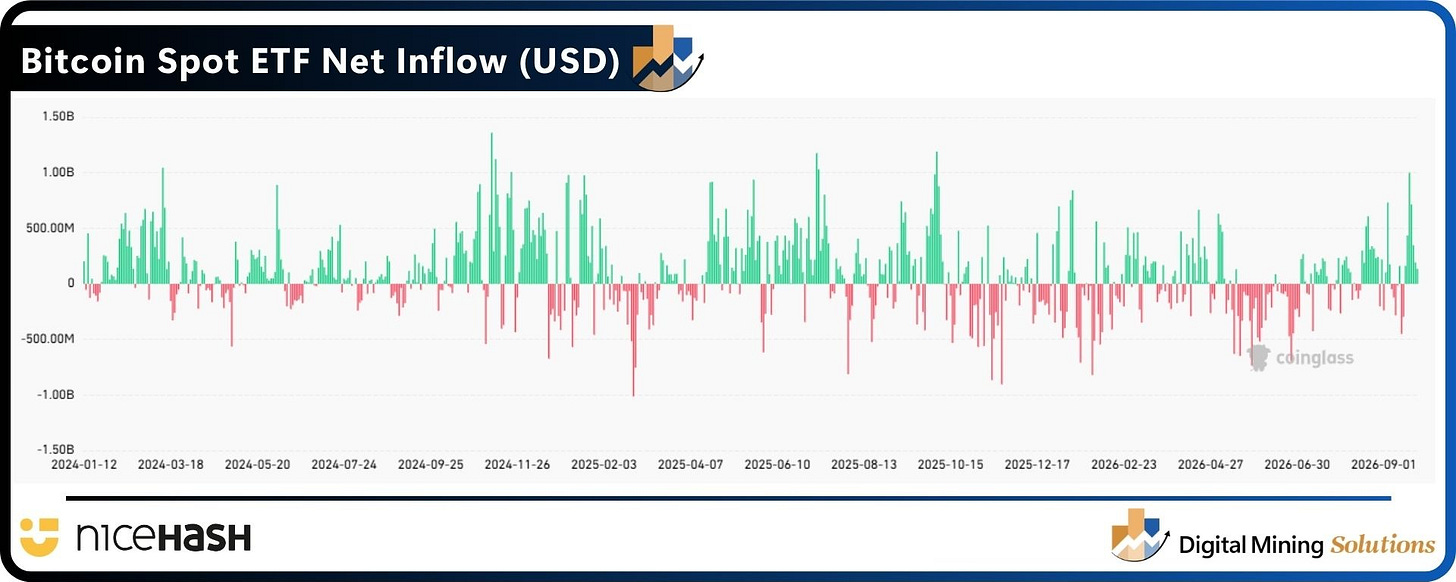
US spot Bitcoin ETFs reportedly attracted approximately $999 million of net inflows on Monday, September 21. Only 7 days in the history of the Bitcoin ETFs witnessed a higher inflow. Across three consecutive trading sessions, cumulative inflows reached approximately $1.59 billion.
Source: CoinGlass
That matters because ETF flows represent actual incremental demand rather than a simple repricing of existing Bitcoin positions. Spot ETF demand gives the move a stronger foundation, although the concentration of inflows in a few trading sessions also creates a risk. If flows reverse or slow materially, the market could lose one of its most important marginal buyers. For miners, a stronger Bitcoin price is obviously positive. However, the relationship between Bitcoin price and mining revenue is not one-to-one as the network adjusts.
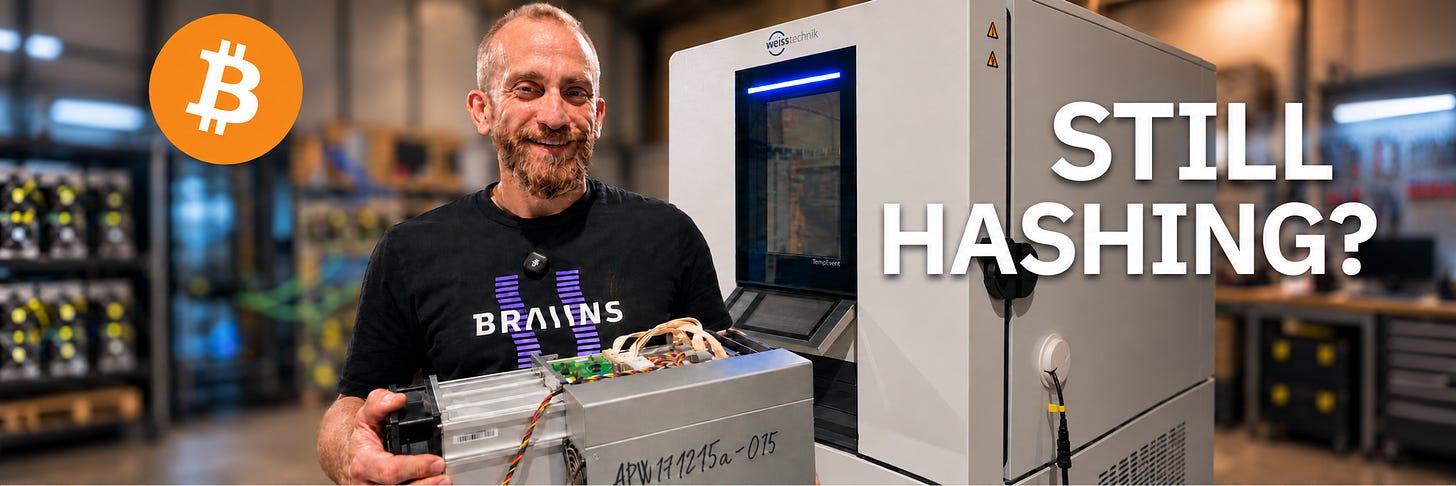
☕️ Braiins did a mining experiment in extreme heat
Braiins heated a barrel of coffee using bitcoin miners, then tested Braiins OS at 45°C. The firmware adjusts power on its own to help prevent heat shutdowns, so your miners keep hashing.
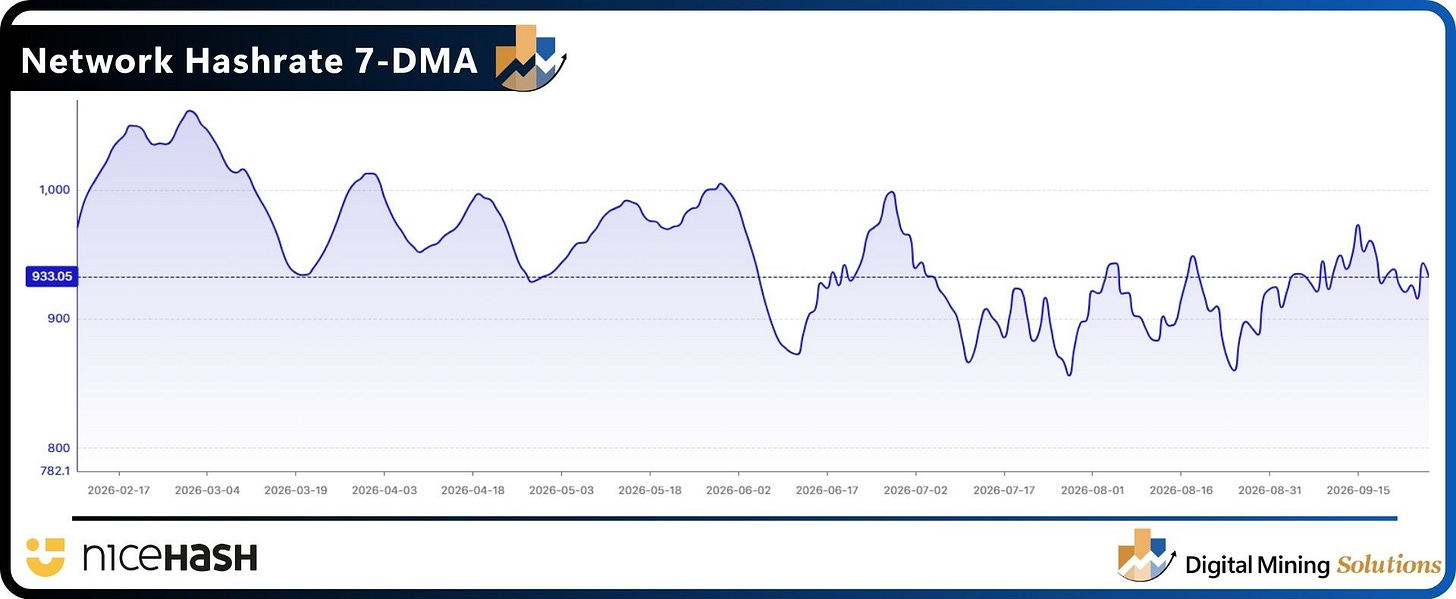
After reaching a two-month high of 973 EH/s, the hashrate 7-day average declined slightly during the week, moving to approximately 915 EH/s. That remains well below the levels seen before the prolonged mining downturn, but the recent surge was enough to push difficulty higher. On September 19, network difficulty increased 4.16% to 132.76T. This is why miners did not capture Bitcoin’s full weekly price increase.
Source: Lincoin Lens
Hashprice Recovered, but Margin Relief Remains Limited
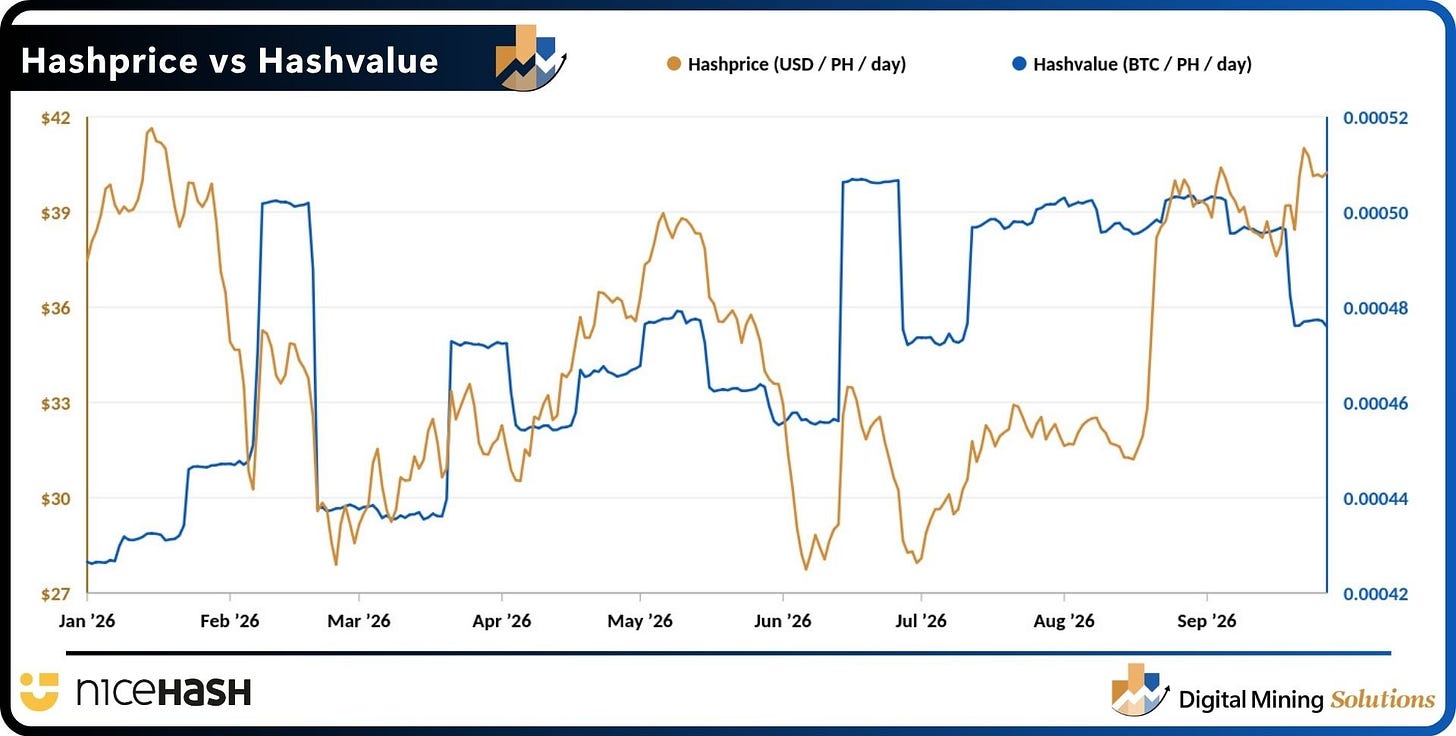
Following the difficulty adjustment, BTC-denominated hashprice declined 3.8%, from 0.0004965 BTC to 0.0004775 BTC/PH/day. Miners earned fewer satoshis for the same hashrate, but those satoshis were worth more in dollar terms. The result was a partial recovery in USD hashprice just above $41/PH/day. Over the past month hashprice has been in a tight range between $39 and $41/PH/day.
Source: Digital Mining Solutions
PowerCompute Adds Hashrate Without Adding Power
Against the backdrop of hashprice still hovering around $40/PH/s/day, PowerCompute’s response is to extract more hashrate from the power it already controls.
PowerCompute is a small US Bitcoin miner operating facilities in Oklahoma and Mississippi. With 771 PH/s of operating hashrate, it controls less than 1 EH/s and ranks around 30th among publicly tracked miners by operating capacity. The planned increase from 771 PH/s to 862 PH/s adds only 91 PH/s. Even after the expansion, PowerCompute would represent less than 0.1% of global hashrate.
So why is it worth mentioning? Because PowerCompute provides a practical example of how smaller and mid-sized operators can respond to difficult mining conditions without developing additional power capacity.
The company is replacing older S19 machines with S19 XP units while continuing to use its existing infrastructure. The program includes 1,000 S19 XP miners scheduled for installation in Oklahoma and another 940 machines ordered for its Mississippi operation. The new units average approximately 132 TH/s at 21.5 J/TH. They replace machines producing around 95 TH/s at approximately 34 J/TH.
That represents nearly 39% more hashrate per machine replaced and a 36.8% improvement in energy efficiency. Once the program is completed, PowerCompute expects its operating hashrate to increase by 11.8% without expanding its power infrastructure or increasing its electricity cost per machine.
The company estimates that the additional hashrate could generate approximately $1.2 million of annual revenue capacity, based on a hashprice of $40/PH/s/day and before curtailment and downtime. That forecast should be treated cautiously. PowerCompute did not disclose the ASIC purchase price, installation costs, expected uptime or proceeds from selling the retired machines. Without those inputs, the payback period cannot be calculated.
The S19 XP is also no longer a leading-edge machine. The investment case therefore depends heavily on the acquisition price and the company’s actual power and operating costs. But that is exactly what makes the example relevant.
Most miners do not control hundreds of megawatts or have access to the capital required for a full fleet replacement buying the latest generation. They operate within fixed power allocations and must decide how to extract more value from infrastructure they already own.
PowerCompute already has the transformers, containers, electrical distribution and operating team. Instead of undertaking a new development, it is concentrating incremental capital on the part of the operation that directly increases production: the machines. Before developing more megawatts, miners should determine whether they can generate more hashrate and more revenue, from the power they already control.
In Texas, securing a queue position is no longer just a paperwork exercise, it can now require millions of dollars in upfront risk capital, with no guarantee the project will receive the permits needed to operate. In the premium section, I break down the new $50,000-per-MW deposit, the permitting freeze and what they mean for valuing mining and AI infrastructure sites.
Download our practical 30-minute guide for mining and infrastructure operators evaluating an AI/HPC pivot.
Learn how to assess your site’s readiness, evaluate the economics, select the right business model, and understand what institutional capital expects so you can reach a clear go/no-go decision before committing capital!