Ethiopia Cut Mining Power to 23%, Hashrate Fell 35%.
Published 9 days ago • 5 min read
Ethiopia’s miners were promised some of the world’s cheapest hydropower. Now tariffs are rising, available power has fallen sharply, and the country’s hashrate dropped 35% in a single quarter. The more interesting story isn’t simply that drought reduced Ethiopia’s mining hashrate, but how quickly one of the world’s most attractive mining markets shifted from abundant cheap power to miners receiving something else than they expected.
Cheap Power Isn’t Cheap If You Can’t Use It
Ethiopia Became Mining’s New Frontier
One of the Grid’s Biggest Customers
Economics Started Changing
The Lesson Isn’t Really About Ethiopia
What Does Power Actually Cost Depends on Availability? - Premium
Sovereign Power Risk Needs a Price - Premium
FBOX’s modular architecture supports phased expansion through standardized cooling, power, and IT modules, providing a consistent framework for AI infrastructure to grow from initial deployments to campus-scale developments. A consistent system architecture enables repeatable deployment and capacity growth while reducing the need for major infrastructure reconfiguration as deployments expand.
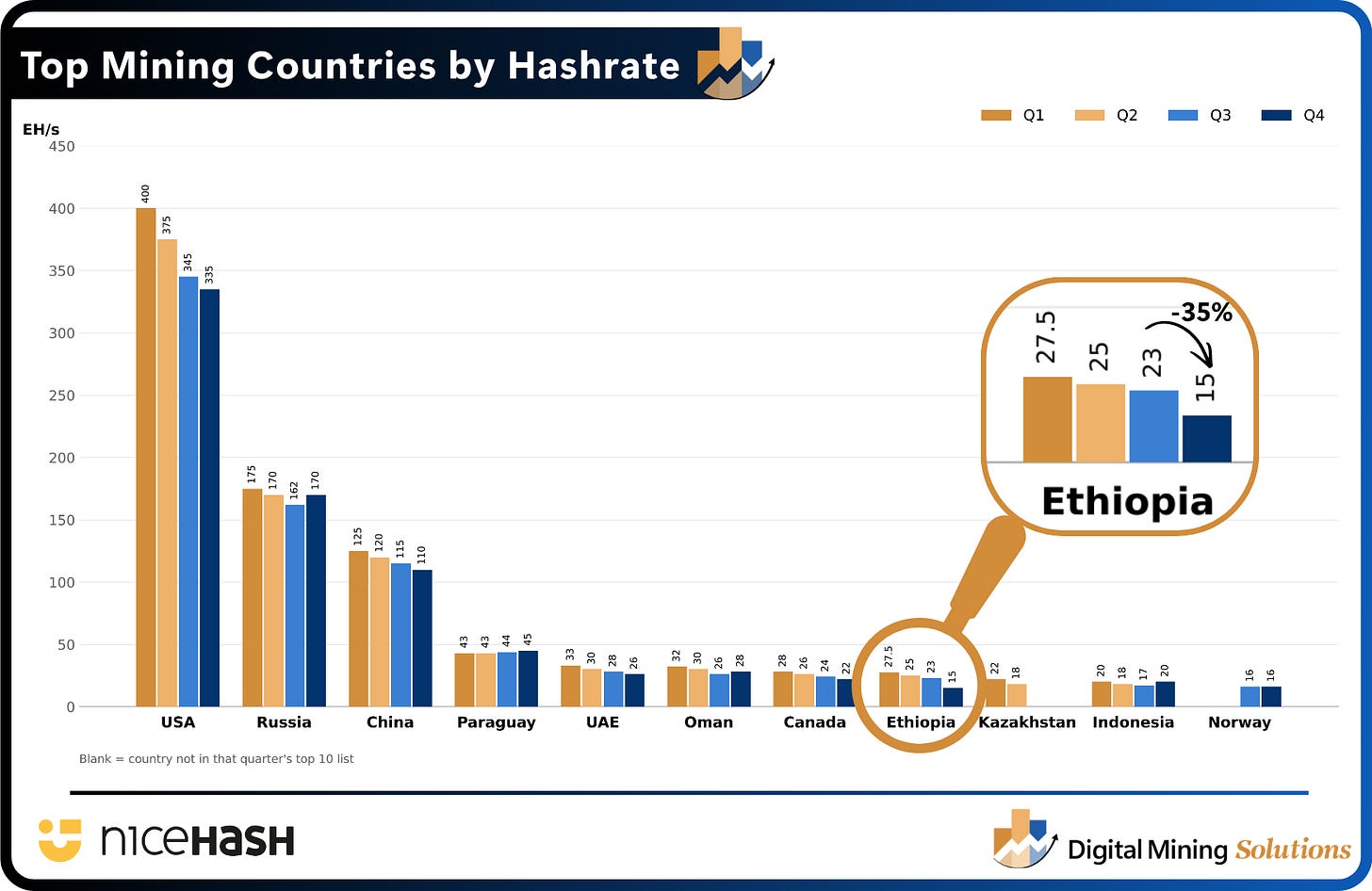
Hashrate Index’s Global Hashrate Heatmap tracks where Bitcoin’s computing power is located and how it moves between countries. Its latest Q4 2026 update shows one particularly striking change: Ethiopia’s estimated hashrate fell from roughly 23 EH/s to 15 EH/s during the third quarter, a 35% decline. The country dropped from eighth to tenth globally and recorded its first material reversal since emerging as Africa’s leading Bitcoin mining market. There are early signs that some Ethiopian mining capacity is returning, but EEP has not yet publicly announced a broad reversal suggesting restoration may be uneven across operators rather than sector wide for now.
Source: HashrateIndex
The immediate explanation for the drop in hashrate is power. Ethiopia’s electricity system is overwhelmingly dependent on hydropower, and reservoir inflows reportedly came in around 20% below expectations amid dry conditions. As generation tightened, Ethiopian Electric Power (EEP) sharply reduced electricity supplied to data-mining customers.
But the more interesting story isn’t that a drought reduced mining hashrate. It is what happened between Ethiopia becoming one of the world’s most attractive mining jurisdictions and miners suddenly receiving a fraction of the electricity they expected. Because the experience exposes something Bitcoin miners sometimes underestimate when evaluating sites, that $/kWh is one of the most misleading numbers in mining when viewed in isolation.
⚡️ No Hardware. No Hosting. Just Hashrate.
Buy bitcoin mining power straight from Braiins and point it where you want. No machines to run, no infrastructure to manage, no long term commitment.
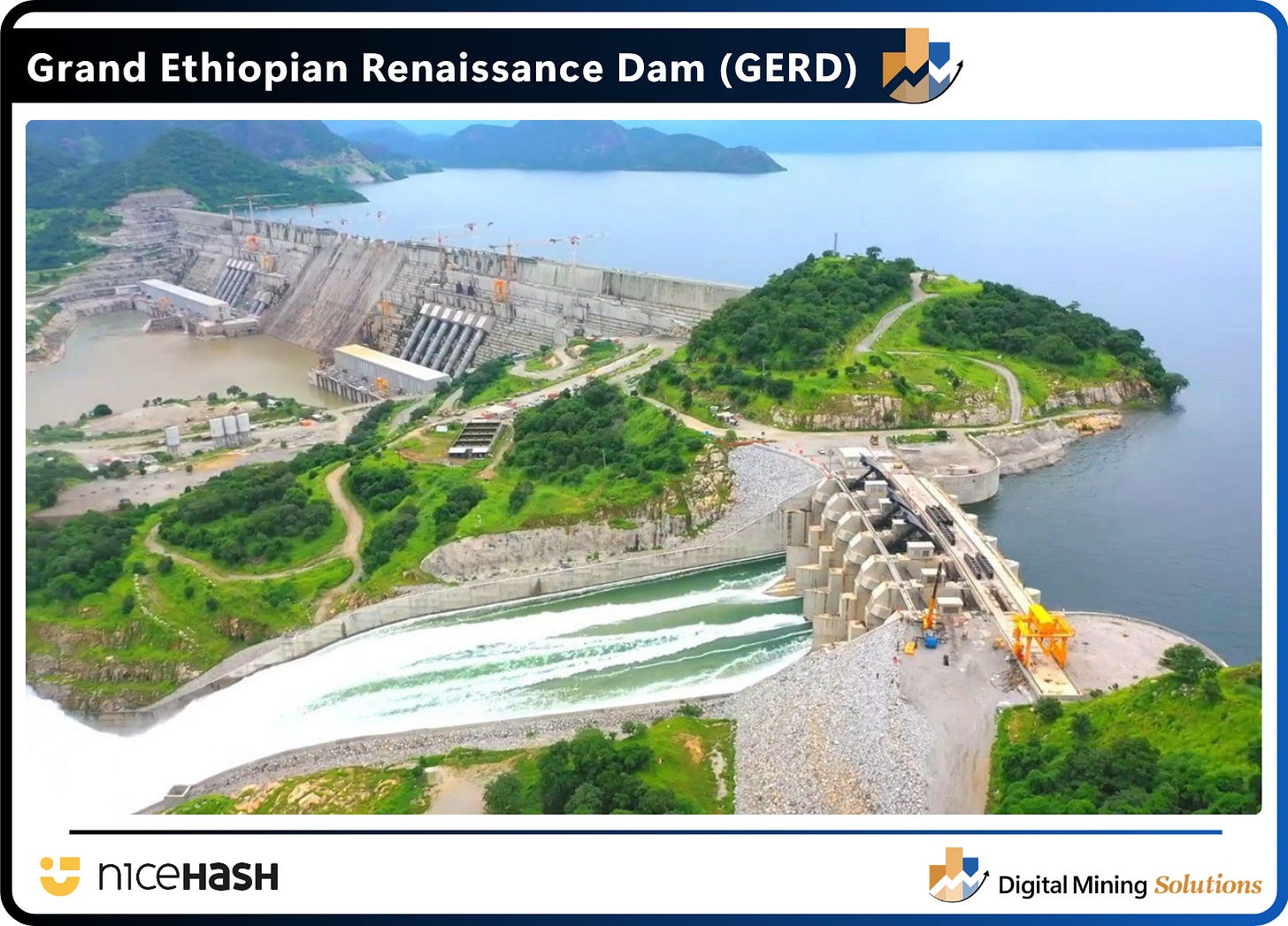
Ethiopia’s rise happened quickly. The country allowed Bitcoin mining in 2022, although cryptocurrency trading itself remained restricted. By early 2024, containers filled with mining machines were appearing near substations connected to the Grand Ethiopian Renaissance Dam (GERD), and Chinese mining companies were among the first major groups moving in.
Source: Ena.et
Ethiopia had abundant hydropower and electricity prices that were difficult to find in most established mining markets. Bloomberg reported in early 2024 that 19 of the 21 companies that had struck agreements with Ethiopia’s power monopoly at the time were Chinese. For Ethiopia, miners offered something valuable as well: a large, flexible industrial customer capable of consuming electricity and paying in foreign currency.
BitFuFu acquired a majority interest in an 80 MW Ethiopian facility in October 2024. The company later disclosed power costs at the site of approximately $0.036/kWh, with up to 4.6 EH/s of potential hashrate. Phoenix Group followed with major expansion of its own. By the end of 2025, Phoenix had 82 MW live in Ethiopia from a secured 132 MW pipeline. That expansion helped push the company’s global hashrate contribution to 15.9 EH/s during Q4 2025.
Ethiopia had gone from an emerging jurisdiction to a meaningful part of the global Bitcoin mining map, ranking number 8 in the world by the end of 2025.
One of the Grid’s Biggest Customers
That growth eventually became large enough to matter at the national level. By 2026, reports indicated that 39 mining companies had power agreements with EEP, with 31 already operational. Miners reportedly accounted for around 35% of EEP’s revenue and consumed close to one-third of national electricity output.
On one level, that sounds like enormous negotiating leverage. A customer segment producing more than a third of utility revenue is difficult to ignore. But Bitcoin mining’s greatest strength as an electricity consumer is also its weakness, ASICs can switch off.
A utility facing inadequate generation cannot easily turn off households, hospitals or politically important industries. Export commitments can also be economically and diplomatically important. Mining, by contrast, is an unusually concentrated and interruptible load. That makes it highly valuable when electricity is abundant and an obvious source of flexibility when electricity becomes scarce.
Hashrate Index describes Ethiopia’s current situation as a hydrology warning rather than a policy reversal. Installed generation capacity has increased, but water availability became the binding constraint. According to estimates, a roughly 20% shortfall in reservoir inflows coincided with Ethiopia losing about one-third of its mining hashrate in a single quarter. That distinction matters. Miners weren’t necessarily pushed out because Ethiopia suddenly decided it didn’t want Bitcoin mining. The electricity simply wasn’t there in the quantities they had expected.
Economics Started Changing
Power availability wasn’t the only variable moving. EEP had already begun changing the economics of mining before the latest severe curtailment.
From December 2025, EEP introduced a revised tariff framework including time-of-use pricing and an availability-based mechanism. Local reporting described a schedule under which the daily average rate would start around $0.04/kWh, move toward $0.05/kWh, and eventually reach approximately $0.065/kWh from July 2027, including VAT and regulatory charges.
That is a significant change for an industry where a one-cent difference in electricity cost can determine which generation of ASIC remains profitable. And it disappears much faster if the electricity itself isn’t available. A nominal four-cent power agreement doesn’t create four-cent mining economics when most of your machines cannot run.
There is still uncertainty around exactly how the 23% allocation has affected individual operators. Restrictions may not be identical at every site. But there is already company-level evidence that Ethiopian power availability matters. BitFuFu reported an unexpected power outage at its Ethiopia facility in April 2026, which contributed to Bitcoin production dropping from 214 BTC in March to 145 BTC in April. The company subsequently said easing curtailment helped improve uptime and production in May.
The Lesson Isn’t Really About Ethiopia
It would be easy to treat Ethiopia as an isolated country-risk story. That would miss the more important lesson. Mining projects are frequently marketed around one headline metric, the price per kilo watt hour.
But a cheap tariff tells you surprisingly little about the quality of an energy asset. A miner paying 4¢ with 98% uptime, a ten-year enforceable agreement and predictable escalation has a fundamentally different asset from a miner nominally paying 4¢ with uncertain curtailment rights and 70% availability.
This is why power should be underwritten on more than price. A useful way of thinking about it is: Real Power Value = Tariff × Availability × Contract Certainty × Duration
Not as a literal mathematical equation, but as an investment framework. The cheapest electricity in the world isn’t particularly valuable if you can’t reliably use it.
A 4¢ power contract can look better than a 5¢ one and still produce worse mining economics. The difference comes down to availability, fixed costs, and the sovereign and contractual risks sitting behind the PPA. In the premium section, we break down why cheap power can become expensive capital and what miners should underwrite before committing to the next frontier market.
Evaluating a Bitcoin mining or digital infrastructure investment? Use our 100-Point Bitcoin Mining Deal Filterto pressure-test the opportunity before capital moves. The DMS DD Scorecard covers hosting, greenfield development, and acquisitions, weighting the key risks that determine whether a deal is worth pursuing.