What looked for eight months like Bitcoin’s most contested governance fight resolved in under 48 hours and resulted in two blocks. That’s the entire output of BIP-110’s enforcing chain, from mandatory signaling at block 961,632 on August 8 to the moment it stopped producing blocks at all. Roughly 97% of Bitcoin’s mining power never signaled. The enforcing nodes split off anyway, exactly as designed, and followed a chain with almost no hashrate left to build it.
The Spam War That Built BIP-110
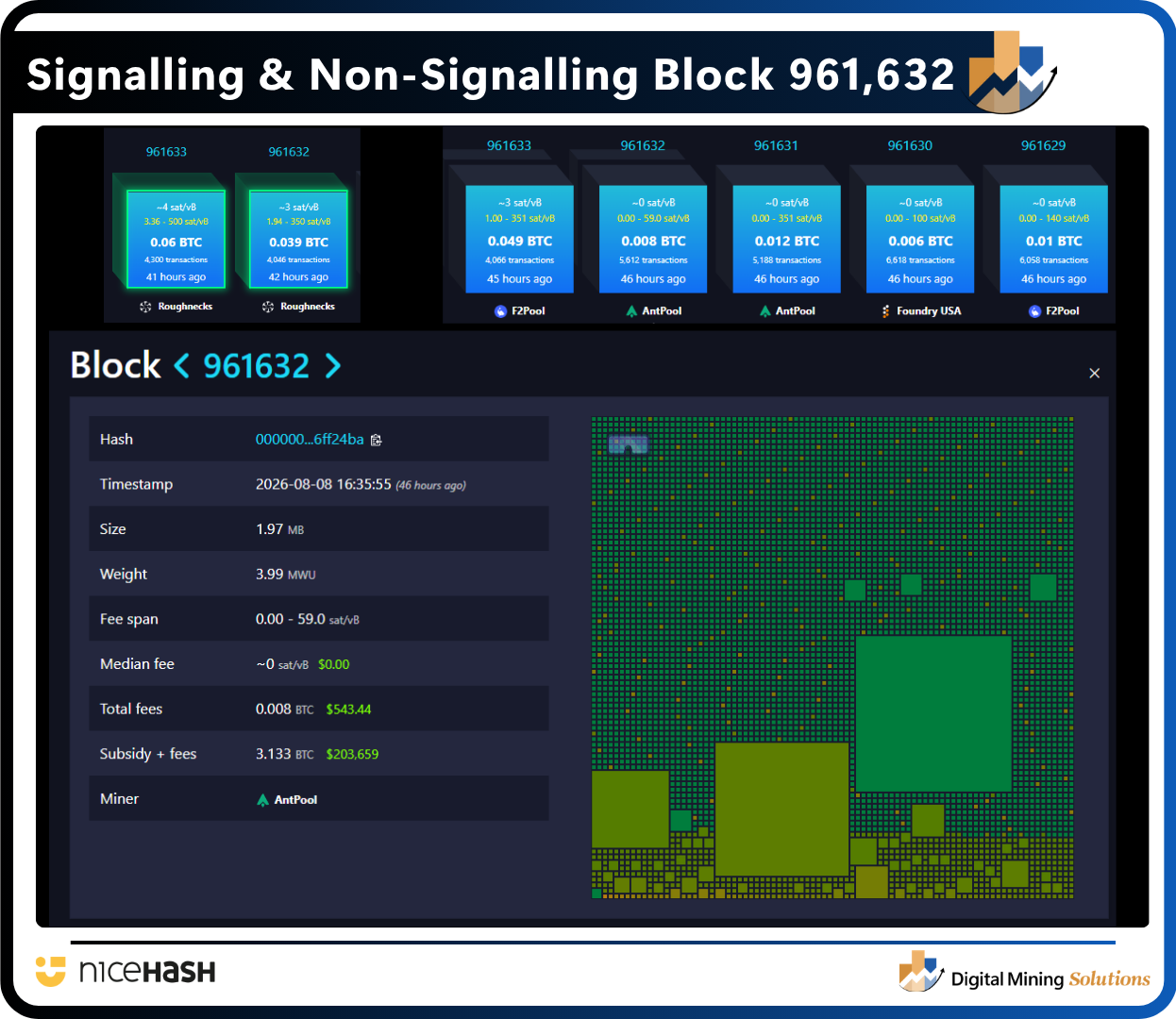
What Actually Happened at Block 961632
Losing the Chain
What Mining Companies Should Take from This
FBOX’s 1.25MW and 10MW AI data center solutions combine direct-to-chip liquid cooling with hybrid air-side cooling systems to meet the thermal demands of modern AI and HPC workloads. Designed for rack densities exceeding 150kW, FBOX delivers efficient, reliable cooling infrastructure built for high-density compute environments.
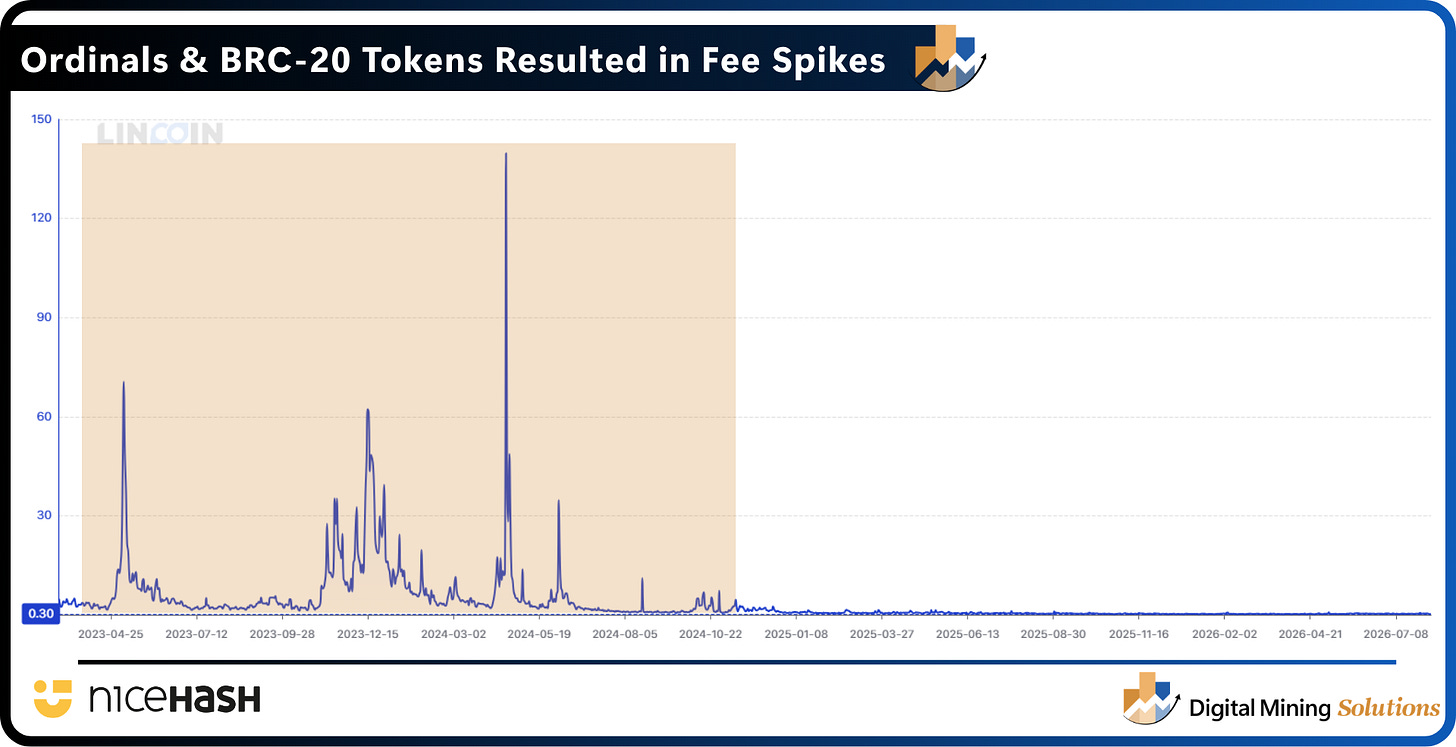
Taproot made cheap on-chain data storage possible in 2021. Ordinals turned that into a movement in 2023, and BRC-20 tokens and Runes followed, filling blocks with content that has nothing to do with moving bitcoin. Some called it spam. Others called it fee-paying demand for block space that Bitcoin’s code doesn’t distinguish.
Source: Lincoin Lens
BIP-110 was introduced in December 2025 by pseudonymous developer Dathon Ohm, with the support of Ocean founder Luke Dashjr. It reached Complete status in the BIPs repository on June 25, 2026, with BIP editor Mark “Murch” Erhardt assigning it the number while calling it “a misguided and unusually careless soft fork proposal”, approval isn’t endorsement.
Michael Saylor spent July building a public campaign against it, publishing “110 Reasons BIP-110 Is a Bad Idea” and comparing the fight to the 2015-2017 Blocksize Wars. None of that opposition needed a line of code to change. The proposal’s own activation design ended up doing the work instead.
What Actually Happened at Block 961632
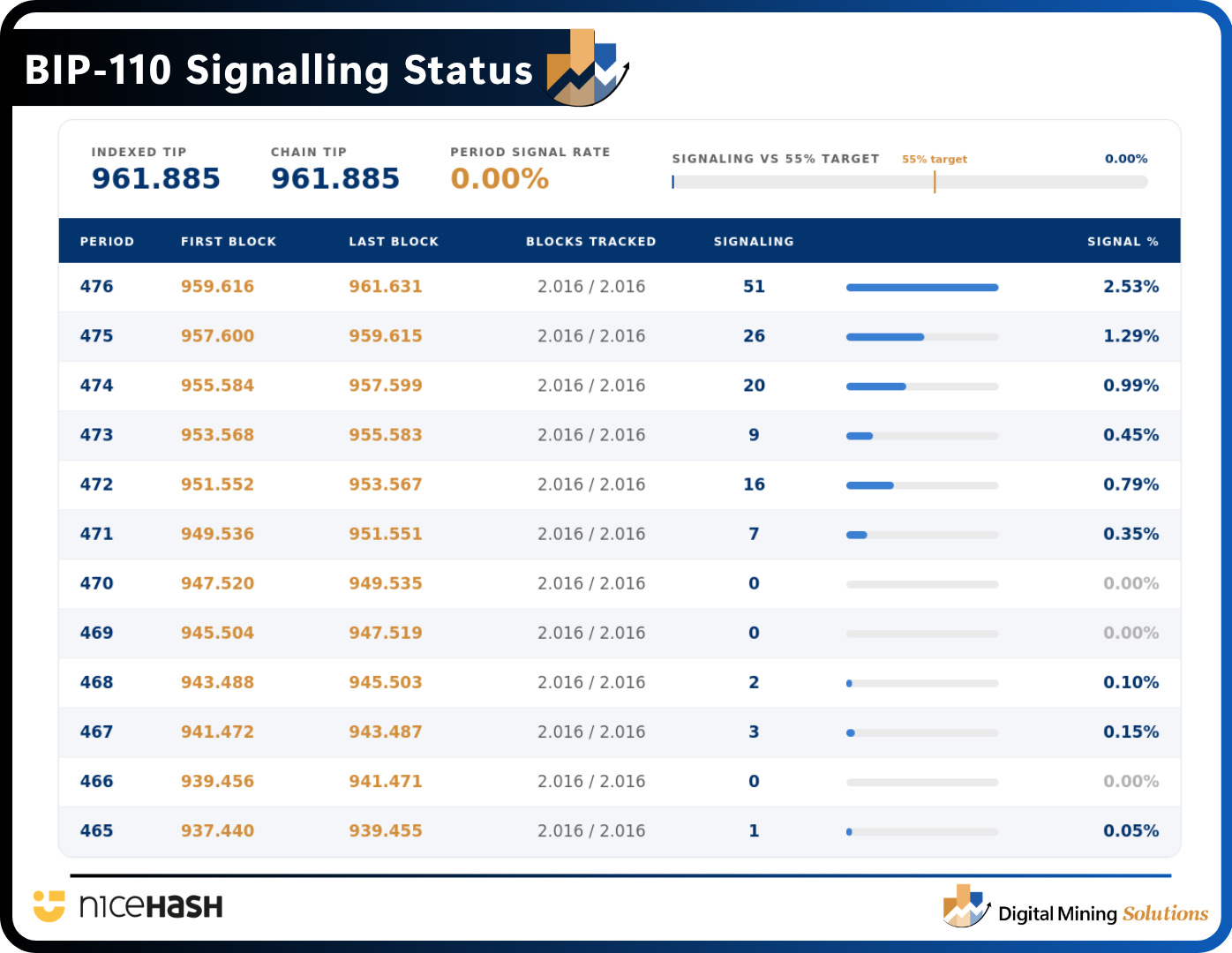
Signalling never got close. Support peaked around 2.53%, just 51 of the preceding 2,016 blocks, against the 55% needed for early lock-in. On August 8 at roughly 19:35 UTC, per CoinDesk, mandatory signalling began exactly as coded: nodes running BIP-110 started rejecting any block that didn’t set version bit 4.
Source: BIP-110 Monitor
AntPool won the race for block 961,632 with a non-signaling block, which the main network accepted and BIP-110 nodes rejected. A miner using Ocean’s DATUM protocol produced the block the breakaway chain followed instead. Roughnecks, the anonymous mining group behind that block, mined one more at height 961,633. Then nothing.
Source: Mempool.space
Bitcoin’s difficulty adjusted at that exact height, resetting to 127.48 trillion just as the chains diverged. That meant the minority branch, running on a sliver of the network’s hashrate, had to solve blocks against the same target as the full network. Within a day the gap had widened to 48 blocks. By the next update, 88. Roughnecks stopped mining the branch entirely on August 8, and monitors now project its next difficulty adjustment could take hundreds of days at current hashrate, if it produces another block at all.
Losing the Chain
BIP-110’s supporters believe something real: Bitcoin should be money, not a data-storage layer. That’s a fair position, and this isn’t about whether they’re right. It’s about what happened when they tried to enforce it.
On August 8, BIP-110 activated exactly as designed. Nodes running the software began rejecting blocks that didn’t comply with its rules. The problem wasn’t ideology. It was math. Roughly 97% of Bitcoin’s hashrate never signaled support.
The BIP-110 nodes enforced the rule anyway, splitting themselves away from the chain followed by almost all of the network’s mining power. They ended up on a chain that rejects nearly all global hashrate while attracting almost none of it.
A chain that can barely produce blocks and cannot realistically adjust its difficulty for years is not a competing version of Bitcoin but a dead end. Enforcing a rule the broader network does not follow does not change Bitcoin, it isolates you from it. In the end, the only thing that matters is whether miners keep building on your chain.
What Mining Companies Should Take from This
Foundry’s clients vote never needed to flip. F2Pool’s refusal cost it nothing. AntPool’s silence turned out to be the correct call, not a missed opportunity. None of the major pools needed strong conviction on the data debate itself. They needed to read the signalling numbers and do nothing until those numbers demanded a decision.
That’s the actual playbook for the next one of these, and there will be a next one. A stricter successor proposal, informally called The Cat, is already circulating. The debate over what counts as legitimate Bitcoin data isn’t resolved. It just lost this round decisively.
For what it’s worth, the fee argument barely mattered here. Inscription revenue was never large enough for pools to fight over in either direction, and that stayed true through the whole episode. The deciding factor was coordination, not economics.
If you operate hashrate or host it, the operational takeaway isn’t “ignore governance proposals.” It’s watch the signalling data, not the rhetoric, and don’t move policy or infrastructure until the numbers actually cross a threshold that matters.
The difference between a well-structured infrastructure investment and a poorly executed one isn’t the thesis. It’s the underwriting, the deal structure, and the people running the project.
Digital Mining Solutions advises investors deploying $5M–$100M into energy-backed digital infrastructure: Bitcoin mining, AI compute, and hybrid energy assets. We cover the full lifecycle: evaluating opportunities before the term sheet, structuring deals that protect the downside, and staying engaged through deployment and operations to make sure capital performs as modelled.
We bring what most investors in this space lack: real operator relationships, a clear framework for underwriting infrastructure economics, and the credibility to sit across the table from developers and vendors on your behalf. Ready to deploy with confidence?