The Four Step Ladder That Decides a Bitcoin Miner's AI Upside
Published 21 days ago • 5 min read
Every operator with land and a power contract is now being told to "do AI." Almost all of them are asking the wrong question. The choice was never whether to run GPUs, it's where you sit on the infrastructure value chain, and what the next step up actually buys you. Bitcoin mining is a ladder of four business models, and the one you're standing on already decides how much AI revenue you can credibly underwrite.
Why Most Miners Are Asking the Wrong AI Question
Four Models, Four Positions on the Chain
The Same Ways to Monetize Compute
The Landlord Move Nobody Talks About
Why Most Sites Can’t Just Convert
The Five Gates That Decide Your AI Opportunity 🔒- Premium Insights
FBOX’s 1.25MW and 10MW AI data center solutions combine direct-to-chip liquid cooling with hybrid air-side cooling systems to meet the thermal demands of modern AI and HPC workloads. Designed for rack densities exceeding 150kW, FBOX delivers efficient, reliable cooling infrastructure built for high-density compute environments.
Every operator with land and a power contract is now being told to “do AI.” Most are asking the wrong question. The question was never whether to run GPUs. It is where you sit on the infrastructure value chain, and what the next step up actually buys you.
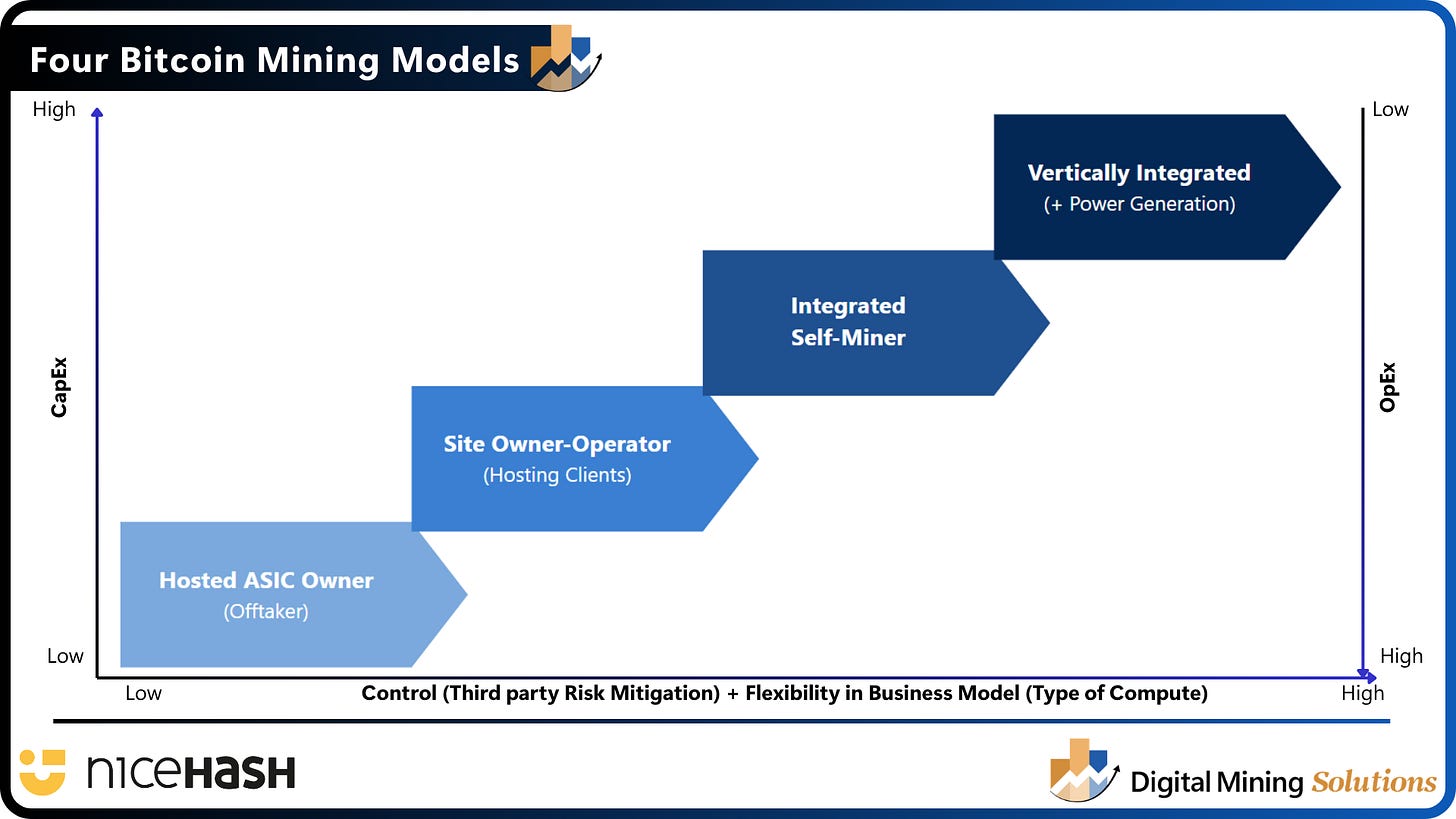
Bitcoin mining is a ladder of four business models, from hosted ASIC owner to vertically integrated power generator. Each step captures more of the margin, improves the economics of the mining you already run, and widens the AI revenue you can credibly underwrite. AI is not a parallel pivot. It is the option that integration creates and a site’s readiness for it is a function of how far up that ladder it can credibly climb.
Four Models, Four Positions on the Chain
Bitcoin mining is not one business. It is four, stacked on top of each other, and each one owns a different slice of the stack. The slice you own sets your capex posture, your margin, and which AI model is your natural first step.
At the bottom is the hosted ASIC owner, the offtaker. You own machines and nothing else. No facility, no power contract, no infra capex. You pay a hosting fee and someone else’s margin leaks out the door with every kilowatt. You also control the least: when the host curtails, your machines go dark; when the host raises rates, you absorb it. It is the fastest way into mining but the weakest position on the chain.
One step up is the site owner-operator hosting client hardware. Now you own the facility and the power contract, and you capture the hosting margin the offtaker above you was paying. Buildout runs $0.3–0.5M/MW. Revenue arrives in fiat or stablecoin on 12-month-plus contracts, which means in most cases you carry no Bitcoin price risk on the machines in your halls as you sell power and uptime, not hashrate.
Add your own fleet and you become the integrated self-miner. You own facility, power, and the ASICs running in them. That captures full margin, but it also means full BTC exposure your revenue now moves with hashprice every block. This is the position most public miners scaled into, and it is the one most sensitive to the cycle.
At the top is the vertically integrated operator with generation like natural gas gensets, behind-the-meter generation, or owned renewables. You take on generation capex, but you secure the lowest and firmest power cost in the system, and you own the scarcest input there is. Power is the constraint that gates every conversation downstream, and at this level you control it rather than rent it.
Source: Digital Mining Solutions
The logic of these models is linear as control and capex rise together, but so does captured margin. The offtaker pays a margin to whoever holds the power contract. The generator captures every layer. And the same gradient governs the AI side, the higher you sit in mining, the higher-value the AI model you can credibly stand up.
The Same Ways to Monetize Compute
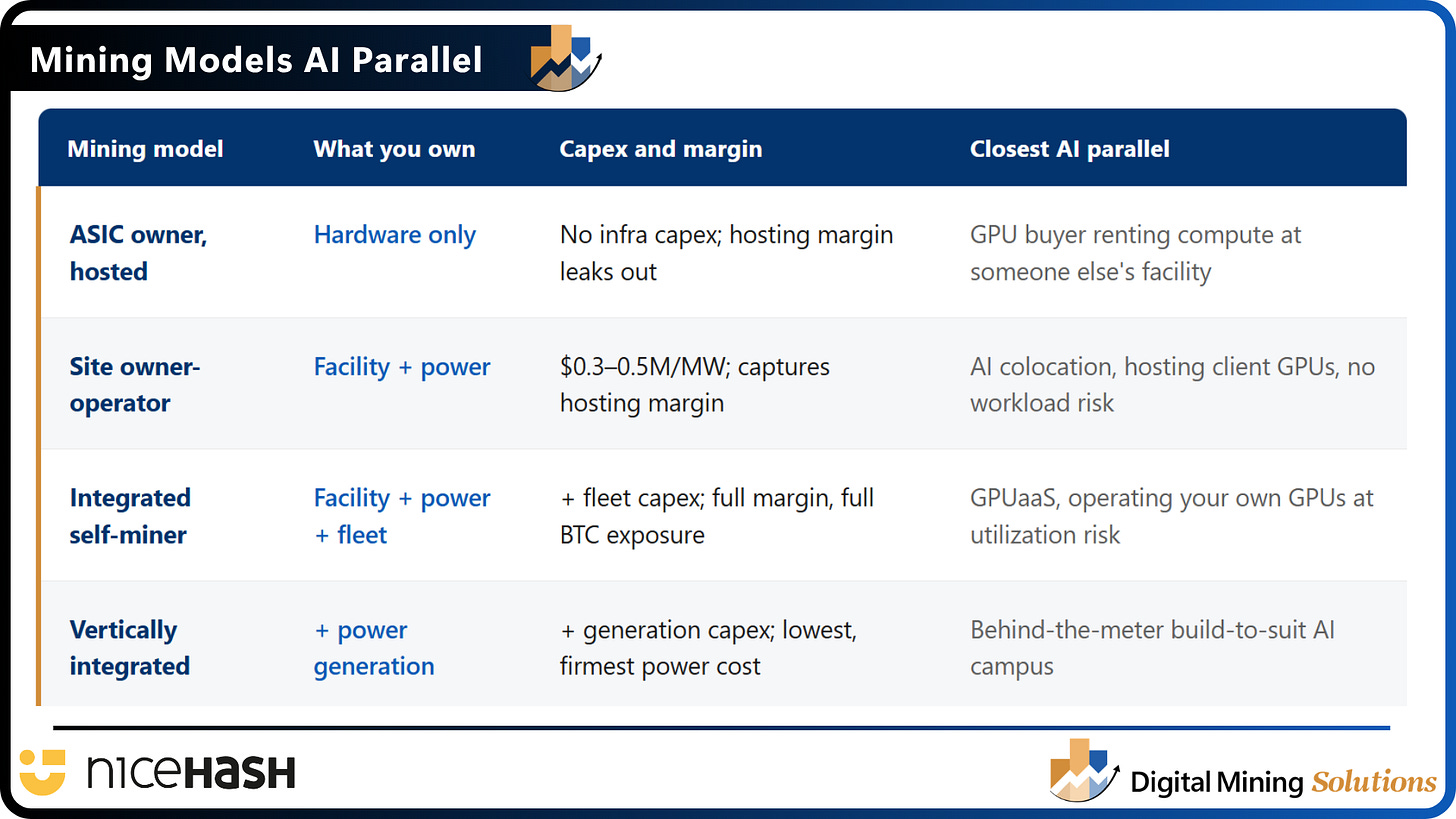
AI compute makes money the same three ways mining does, which is why the mapping is exact rather than loose analogy. You own and operate the hardware (self-mining, or in-house AI infrastructure). You host someone else’s hardware (mining hosting, or AI colocation). Or you sell cycles rather than space (cloud mining, or GPUaaS).
Source: Digital Mining Solutions
The mapping is the actionable part. An operator already hosting client ASICs converts most naturally to AI colocation. A self-miner can stand up GPUaaS. A generator can underwrite build-to-suit. You don’t pick an AI model in the abstract as your current mining model already tells you which one is one step away. The mistake is reaching two steps up, underwriting GPUaaS utilization risk when your operational muscle only supports colocation.
The Landlord Move Nobody Talks About
The roadmap adds one position the model table leaves out: the powered-shell landlord. It is not a way of mining. It is a way of monetizing land and power a miner already controls, by leasing them to an AI developer who builds out and runs the facility.
That makes it the lowest-risk entry into AI economics. You secure the land and interconnection, then lease them to a developer who takes on the buildout and operations. You earn ground or shell rent plus the margin that actually matters: a premium on power. You secured interconnection at one price; the tenant pays a premium on top, because grid queues in primary markets run past four years and they have no faster route to energized megawatts.
This captures AI economics with zero operational uplift. No Tier 3/4 retrofit, no liquid cooling, no SLA exposure, no utilization risk. It is also a defensible end state, not merely a stepping stone. An operator with no appetite to run AI infrastructure can rationally stop here and still monetize the AI cycle.
Why Most Sites Can’t Just Convert
The assumption that any mining facility can be “converted” to AI is the most expensive misconception in the market. The capex tells you why. Mining-grade buildout runs $0.3–0.5M/MW. Retrofitting an existing mining data center to AI spec runs roughly $1.5–3M/MW. Greenfield AI runs $8–11M/MW, ten to twenty times the cost of the mining shell you already own.
And the revenue profile is different in kind. AI carries no block-reward floor. Where mining produces a predictable output every block regardless of how full your halls are, AI revenue is utilization-dependent — empty racks earn nothing. Most mining sites were built for deployment speed and flexible load, not Tier 3/4 density, redundancy, and the uptime guarantees AI customers screen for.
The public miners have shown both the prize and the bar. Core Scientific and TeraWulf have committed the majority of their contracted capacity to AI workloads, but they did it with balance sheets and operational teams most operators don’t have. The lesson for everyone below that tier is sequencing: validate the site before you finance the hardware. The site, not the GPU order, is what gates the deal.
🔒 This section is for premium subscribers: The analysis above maps the ladder. What follows is the five-gate filter that tells you which level your specific site can actually reach and which AI conversations to stop chasing.