When Hashprice Falls Below $40, Smarter Mining Becomes a Competitive Advantage
Published about 6 hours ago • 6 min read
Historically, miners have focused on securing cheap electricity, acquiring efficient hardware, and maximizing uptime. Those fundamentals remain important, but increasingly, the best mining operators are optimizing against a much broader set of variables like hashprice and electricity pricing. The most profitable mining strategy is not necessarily to maximize hashrate or uptime. It is to maximize the economic value generated by every megawatt consumed.
Mining Profitability Is No Longer Just About Cheap Power
Beyond Traditional Curtailment
How Price Adapt Determines the Optimal Operating Point
Older Hardware Has More to Gain
Up to 36% Higher Modelled Profit
From Fleet Monitoring to Automated Profit Optimization
The Next Competitive Advantage in Mining
Braiins Manager is one platform to manage, automate and optimize mining operations across all your locations. Monitor every site and miner in real time, and let Controlflow handle routine tasks automatically. Get more from every megawatt with automated demand response participation and Price Adapt, which sets each miner to its most profitable power level as electricity prices and hashprice change.
Mining Profitability Is No Longer Just About Cheap Power
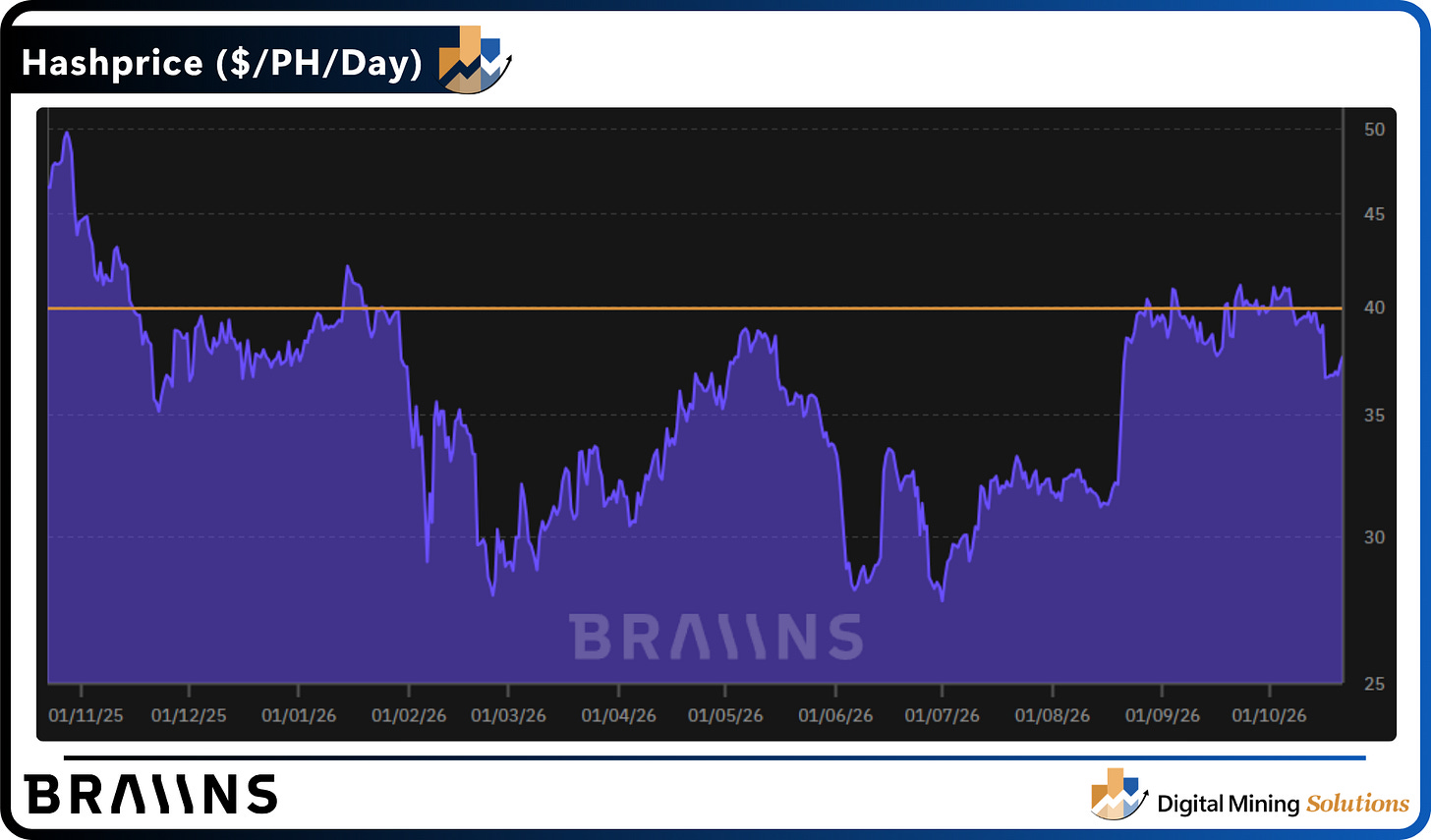
Bitcoin mining economics have been under significant pressure in 2026. With hashprice falling below $40/PH/day, many operators face a difficult combination of declining revenue per unit of hashrate, and electricity prices that can change dramatically throughout the day.
At $40/PH/day, a mining machine at 200 TH/s generates just $8 in daily revenue before electricity and other operating costs. For operators running thousands of machines, even small changes in power prices or efficiency can determine whether an operation generates positive cash flow.
Historically, miners have focused on securing cheap electricity, acquiring efficient hardware, and maximizing uptime. Those fundamentals remain important, but increasingly, the best mining operators are optimizing a much broader set of variables.
Hashprice determines the revenue opportunity. Electricity pricing determines the cost of capturing it. Hardware efficiency determines how effectively power is converted into hashrate. And operational flexibility determines whether miners can respond when those variables change.
The most profitable mining strategy is not necessarily to maximize hashrate or uptime. It is to maximize the economic value generated by every megawatt consumed. This distinction becomes particularly important in volatile electricity markets such as ERCOT and PJM, where wholesale power prices can fluctuate significantly between individual hours.
A miner that is profitable at 3 AM might be operating at a loss by 3 PM. Similarly, operating hardware at maximum performance is not always the most profitable approach, even when electricity remains relatively inexpensive. This creates an opportunity for software-driven optimization.
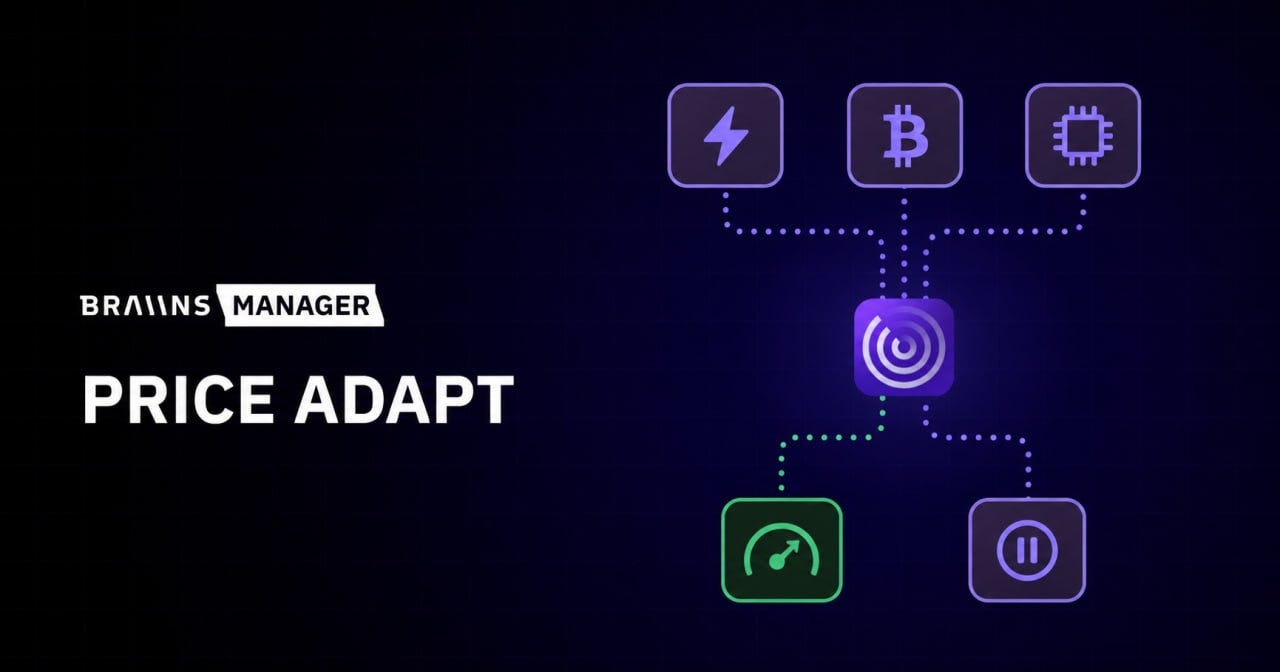
Braiins has introduced Price Adapt, a profitability optimization engine within Braiins Manager that automatically adjusts mining operations according to hashprice, electricity prices, and individual miner efficiency. Rather than treating mining as a simple on/off operation, Price Adapt finds the most profitable operating point for each supported machine.
Beyond Traditional Curtailment
Curtailment is already a familiar concept among Bitcoin miners, particularly in Texas. When electricity prices rise above a predetermined threshold, mining operations temporarily shut down. Once prices fall, the machines resume hashing. This approach protects operators from periods when the cost of electricity exceeds expected mining revenue.
However, traditional curtailment has an important limitation: it generally treats mining as a binary decision. A machine is either running or switched off. In reality, mining hardware offers a range of potential operating configurations. Depending on firmware capabilities, miners can increase or decrease their power consumption, changing both their hashrate and efficiency.
When using Braiins OS a third option is introduced, between full-power operation and complete shutdown. Instead of asking whether a machine should be running, operators can ask at what power level that machine generates the highest profit. When electricity is particularly cheap, overclocking may generate additional revenue that exceeds the incremental electricity cost. As power prices increase, underclocking can improve efficiency enough to preserve profitability. When electricity becomes too expensive for any available operating configuration, shutting down remains the economically rational decision. Price Adapt automates these decisions using the expected profitability of individual machines.
How Price Adapt Determines the Optimal Operating Point
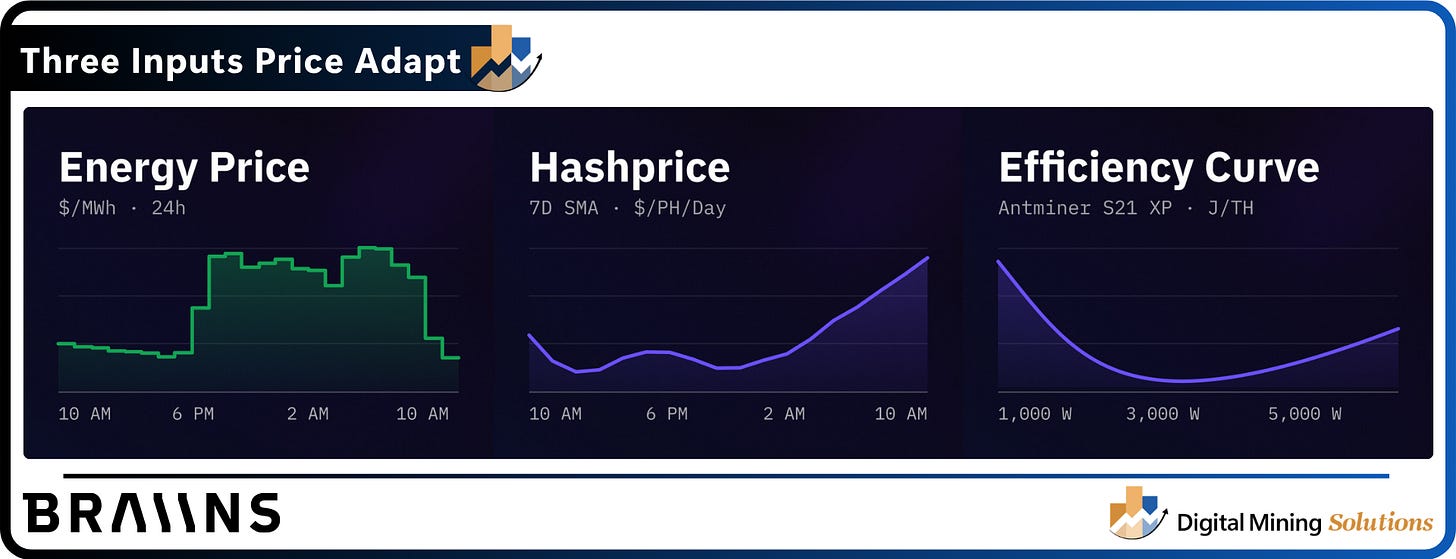
The system combines three principal inputs: electricity prices, hashprice, and miner efficiency.
Electricity pricing comes from the Day-Ahead Market, currently supporting ERCOT and PJM. Hashprice is calculated using a seven-day average, reducing the impact of short-term fluctuations. Miner efficiency is modelled across the supported hardware’s operating range.
Using these variables, the software estimates the hourly net profit associated with different power settings.
The calculation is simple:
Hourly net profit = (Mining revenue per MWh − Electricity price per MWh) × Power consumption in MW
An adjustable tolerance allows operators to fine-tune profitability thresholds. A negative tolerance accounts for additional electricity costs beyond the wholesale power price, while a positive tolerance allows miners to operate more aggressively, potentially accepting lower immediate margins in anticipation of future Bitcoin price appreciation.
Importantly, Price Adapt maximizes estimated hourly profit rather than simply choosing the setting with the lowest energy consumption per terahash.
Consider a miner with several available power targets. At low electricity prices, increasing consumption might produce additional hashrate and higher total profit, even if energy efficiency deteriorates slightly. As electricity prices rise, the additional revenue from operating at higher power targets may no longer justify the cost. The optimal setting then shifts toward greater efficiency. Eventually, the machine reaches a point where no available operating configuration generates a positive estimated margin. At that point, the software schedules curtailment.
This optimization occurs individually for supported miners, recognizing that different models have different efficiency curves and breakeven electricity prices.
Older Hardware Has More to Gain
The economic benefits of adaptive power management are particularly interesting for operators managing mixed-generation fleets.
Consider the Antminer S19j Pro and the newer Antminer S21 XP. Both convert electricity into hashrate, but their efficiency characteristics differ significantly. An older S19j Pro generally has a lower breakeven electricity price, leaving less room to operate profitably when energy prices increase. The newer S21 XP benefits from greater efficiency and can remain profitable across a wider range of electricity prices.
A conventional curtailment strategy might use a fixed threshold across groups of machines, potentially missing these differences. Price Adapt evaluates supported miner models independently, allowing different hardware generations to operate according to their respective economics.
This matters because older machines do not necessarily need to operate continuously to remain economically useful. Under the right electricity pricing conditions, selectively operating older hardware can still generate positive contribution margins. The opportunity is not to make inefficient hardware universally competitive with newer machines. It is to identify precisely when running that hardware makes financial sense and automatically apply the most profitable settings.
Up to 36% Higher Modelled Profit
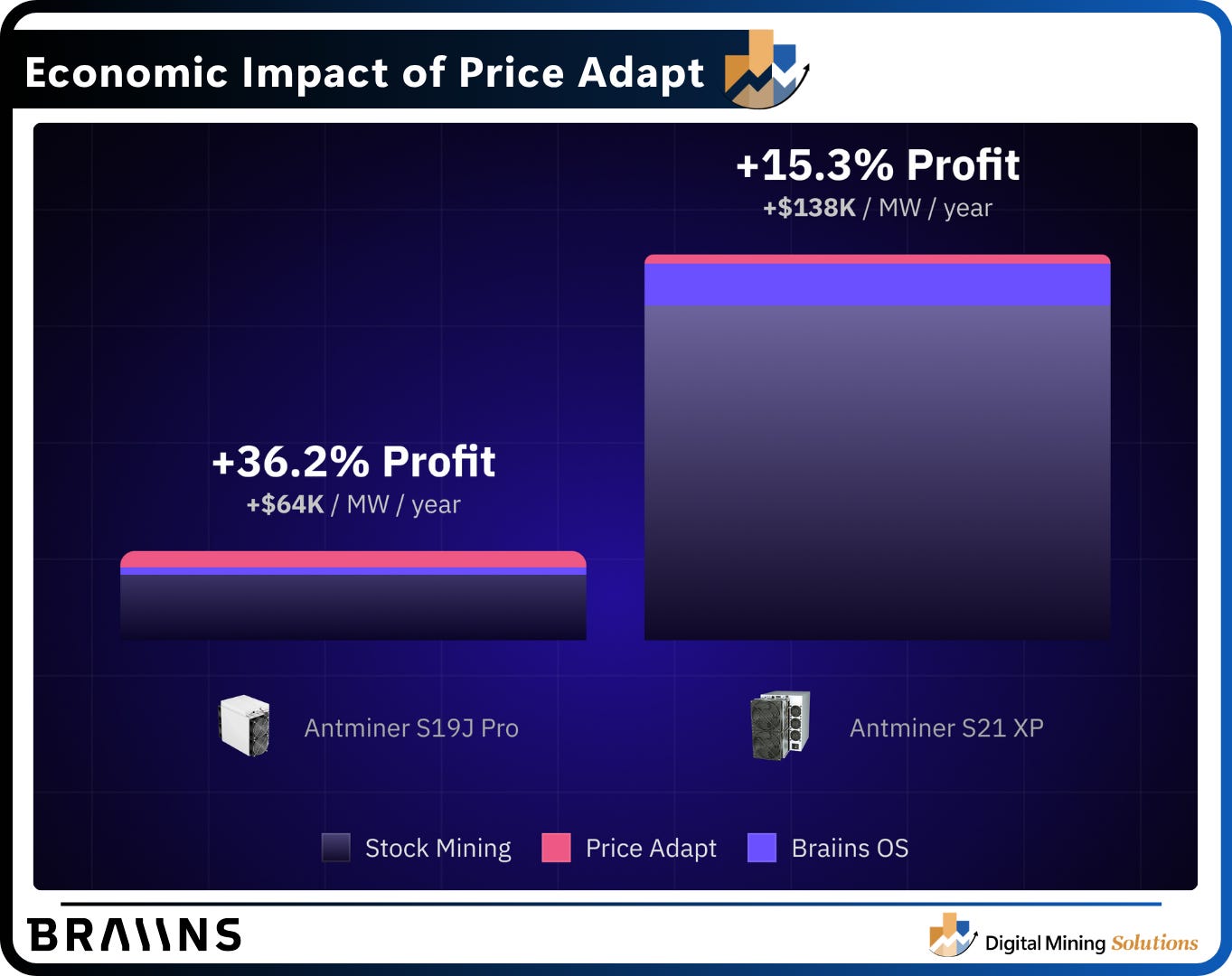
Braiins modelled the economic impact of Price Adapt using 2025 ERCOT LZ_WEST Day-Ahead electricity prices, a 1 MW mining site, trailing seven-day hashprice, and Braiins OS efficiency curves. The analysis compared conventional mining using stock firmware against optimized operation using Braiins OS and Price Adapt.
The corresponding estimated annual profit improvements were approximately $64,000 per MW (a 36.2% increase) for the S19j Pro and $138,000 per MW (a 15.3% increase) for the S21 XP. The older S19j Pro showed the larger percentage improvement, largely because adaptive power management helps avoid operating during periods when its narrower margins become uneconomic. The S21 XP generated the larger absolute profit improvement because its greater efficiency supported a stronger underlying earnings profile.
These are modelled results, not guaranteed operational returns. Actual performance depends on electricity market exposure, hashprice, fleet configuration, site costs, and operational constraints. Nevertheless, the findings illustrate how software optimization can meaningfully influence mining economics without requiring additional power capacity or new ASIC investments.
From Fleet Monitoring to Automated Profit Optimization
Price Adapt operates through Braiins Manager, where operators connect their electricity market, define mining locations, configure profitability tolerances, and select the machines subject to optimization. The system develops an hourly operating schedule based on Day-Ahead Market prices.
For supported miners running Braiins OS, the software can overclock, underclock, pause, or resume individual machines. Stock firmware and unsupported devices can still benefit from automatic pausing and resuming, although granular power-target optimization is unavailable.
Operators can review planned curtailment events, historical actions, and upcoming schedules. Site-level capacity constraints can also be incorporated, preventing optimized power settings from exceeding a configured MW limit.
The financial outcome depends on the operator’s actual power procurement arrangements. Sites with fixed-price electricity contracts may capture less value from hourly price optimization than facilities directly exposed to wholesale market volatility.
The Next Competitive Advantage in Mining
Bitcoin miners have spent years competing on hardware efficiency, electricity procurement, and infrastructure costs. Those factors will continue to determine the industry’s cost curve. But as hashprice compresses, operational intelligence becomes another increasingly important competitive variable.
A miner that can dynamically adjust consumption to market conditions has more flexibility than one operating continuously at a fixed power target. For operators with substantial existing infrastructure, the potential value is particularly compelling: higher profits may be achievable without acquiring more ASICs or securing additional grid capacity.
The next frontier in Bitcoin mining efficiency is not simply how many joules are required to produce a terahash. It is how intelligently operators decide when, and at what power level, to produce that terahash. In an environment where hashprice can fall below $40/PH/day, that distinction increasingly matters.
Braiins Manager is one platform to manage, automate and optimize mining operations across all your locations. Monitor every site and miner in real time, and let Controlflow handle routine tasks automatically. Get more from every megawatt with automated demand response participation and Price Adapt, which sets each miner to its most profitable power level as electricity prices and hashprice change.