Why the Price per GPU No Longer Tells You What an AI System Costs
Published 16 days ago • 4 min read
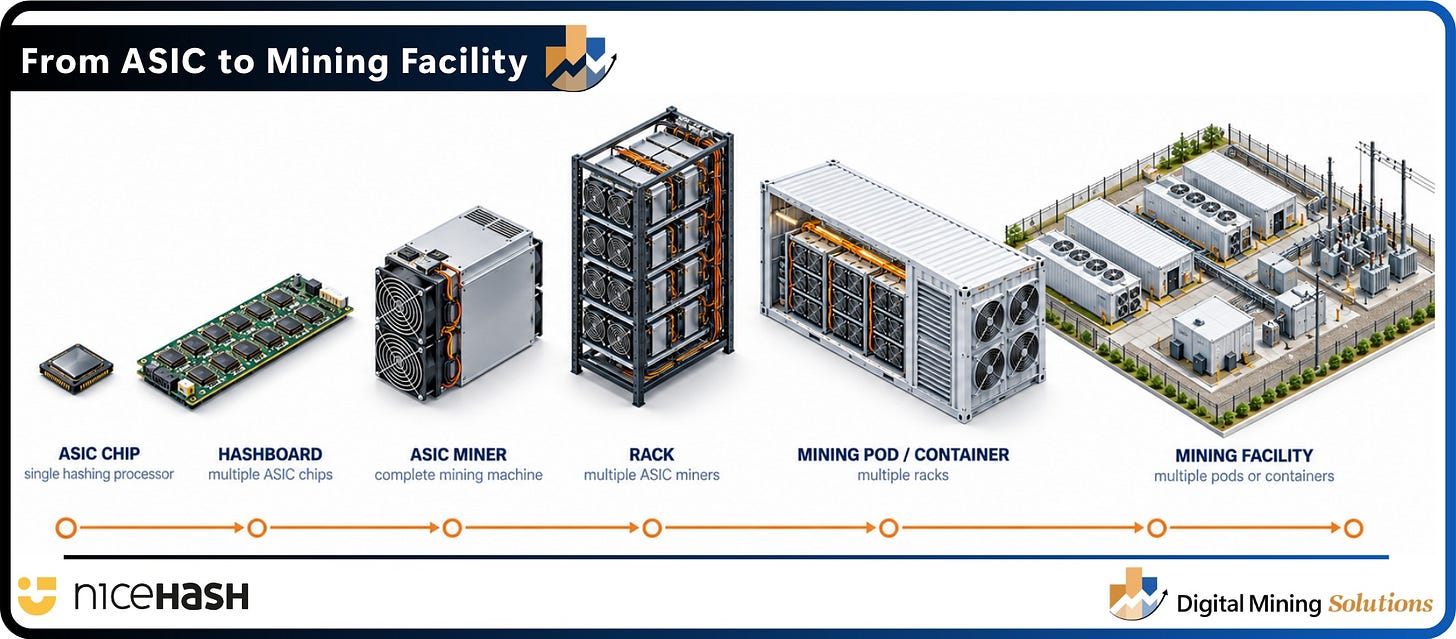
GPU, node, server, system and rack are often used as if they were interchangeable. Each actually describes a different layer of the hardware stack, with different costs and infrastructure requirements. Bitcoin miners have already learned a version of this lesson. An ASIC chip is not an ASIC miner. An ASIC miner is not a rack, and a rack is not an operating mining facility. AI infrastructure follows the same logic, but with more layers and far greater dependence on networking, cooling and software.
The Basic Hierarchy from Chip to Campus
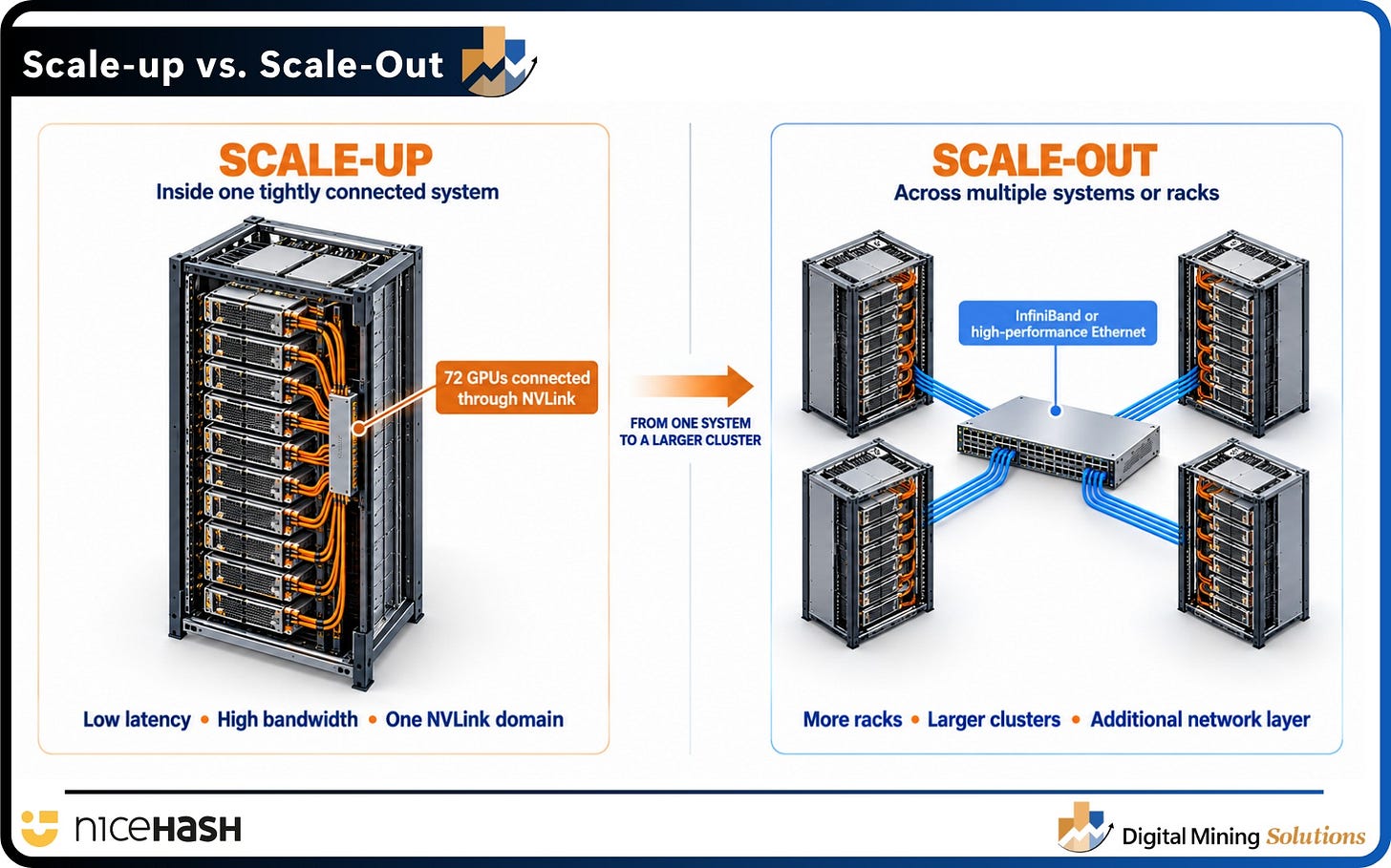
Scale Up and Scale Out
What Is Actually Included in the Price
Installed GPUs Versus Sellable Compute - Premium
The Buyer’s Final Checklist - Premium
FBOX’s modular architecture supports phased expansion through standardized cooling, power, and IT modules, providing a consistent framework for AI infrastructure to grow from initial deployments to campus-scale developments. A consistent system architecture enables repeatable deployment and capacity growth while reducing the need for major infrastructure reconfiguration as deployments expand.
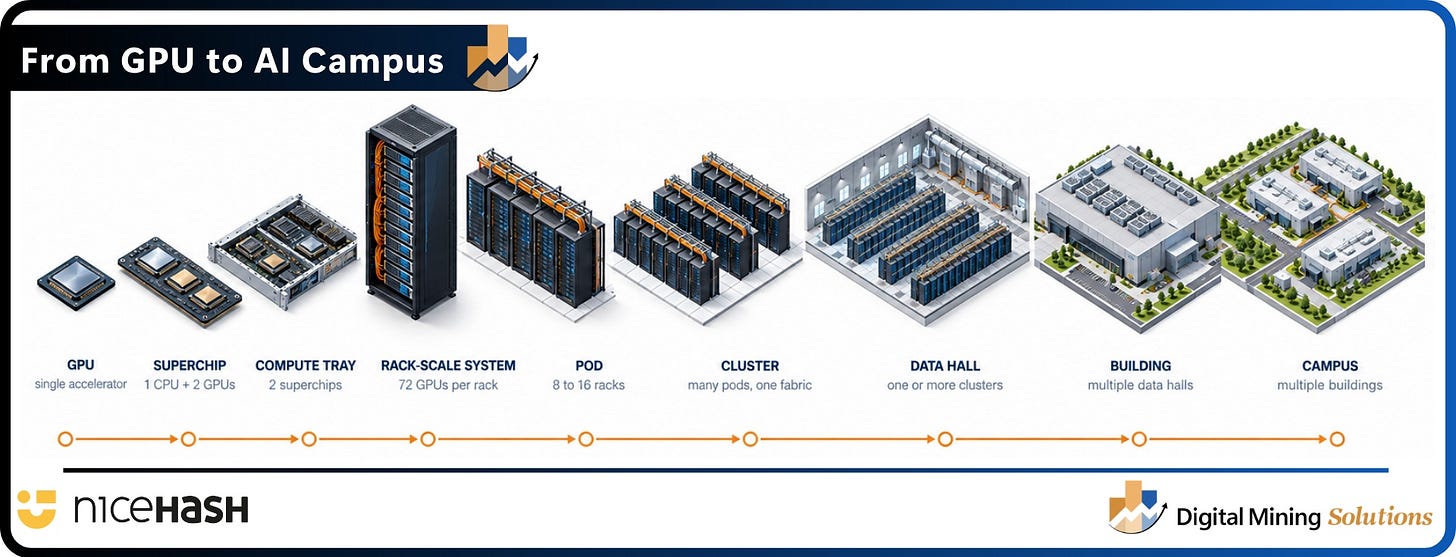
The easiest way to understand AI infrastructure is to build it from the bottom up. At the first level is the GPU, the processor responsible for most AI calculations. NVIDIA’s Blackwell Ultra (B300) is one example. Like the individual ASIC chips mounted inside a Bitcoin miner, the GPU is the compute engine, but it is not a complete operating machine.
Each GPU is packaged together with high-bandwidth memory and then mounted on a board with a CPU and high-speed connections. In NVIDIA’s GB300 architecture, two Blackwell Ultra GPUs and one Grace CPU form a GB300 Superchip, roughly the counterpart of a hashboard. Two Superchips form one compute tray, giving it two CPUs and four GPUs.
The compute tray is roughly comparable to the individual ASIC miner in a mining facility: a functioning unit containing compute and supporting components. The analogy is imperfect, but it establishes the difference between the chip and the machine containing it.
Eighteen compute trays are then combined in a GB300 NVL72 rack-scale system. Together, they provide 72 Blackwell Ultra GPUs and 36 Grace CPUs. Nine NVLink switch trays connect those GPUs into one high-speed domain. Above the rack, multiple systems are connected into pods, and multiple pods into clusters. These are logical groupings. Physically, they are deployed in data halls, which sit inside buildings, which together make up a data center campus.
For a Bitcoin miner, the equivalent chain looks like this:
This reveals why saying “we are buying GB300s” is insufficient. Does that mean GPUs, Superchips, compute trays or complete NVL72 racks? Vendor terminology also varies: “node,” “server” and “tray” may describe similar equipment, but the number of GPUs inside can differ. The number of nodes therefore means little without the configuration.
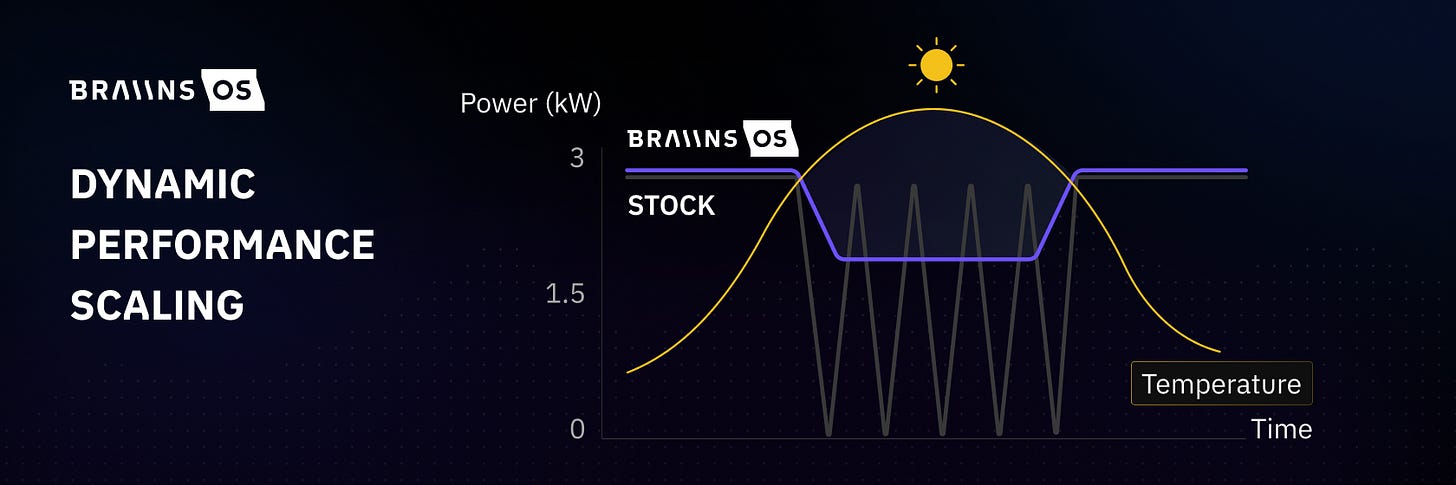
🌡 Your Miners Throttle. Ours Scale.
When the room gets hot, stock firmware stops and you lose the day. Braiins OS scales performance down instead, so the machines keep hashing through the heat.
Up to 100% uptime in hot conditions, against about 20% on stock firmware.
The main difference between mining equipment and AI systems becomes visible in the network. ASIC miners operate largely as independent machines. Thousands can contribute to the same pool without exchanging data with one another. If one goes offline, the rest continue hashing.
Large AI workloads are different. GPUs working on the same model must continuously exchange data. How they are connected affects how efficiently they can operate together.
Scale-up refers to the high-speed connections inside a tightly integrated system. In the GB300 NVL72, NVLink connects 72 GPUs into one domain designed to behave like a very large accelerator. This helps overcome the communication bottlenecks that emerge when a model is distributed across many processors.
Scale-out begins when separate nodes or rack-scale systems are connected into a larger cluster. This normally requires InfiniBand or high-performance Ethernet such as NVIDIA Spectrum-X, together with switches, cables and optical transceivers.
Seventy-two GPUs connected through NVLink are therefore not equivalent to 72 independent GPUs across ordinary servers. Interconnect bandwidth, latency and software determine how much useful work the system can perform.
For miners, networking primarily sends work and shares between machines and the pool. For AI operators, networking is part of compute performance. A weak network can leave expensive GPUs waiting for data or for one another.
What Is Actually Included in the Price
This hierarchy explains why apparently similar AI hardware offers can differ by millions of dollars. A quotation may refer to any of four very different scopes:
Individual GPUs or GPU modules
Complete compute trays or servers
Integrated rack-scale systems
Installed and commissioned clusters ready for workloads
Bitcoin miners recognize the distinction. An ASIC’s factory price is not its deployed cost. Freight, duties, racks, power distribution, installation and cooling still sit between purchase and productive hashrate.
For AI, a rack quotation may also omit scale-out switches, optics, storage, software, cooling distribution units, power connections, commissioning, spare parts and support.
Even “complete rack” can mean only that the OEM equipment has been assembled. The facility must still match its electrical, cooling and network interfaces, and someone must take integration responsibility.
The relevant number is therefore not the headline hardware price. It is the fully installed and commissioned cost of a system capable of passing its acceptance tests and running the intended workload.
Installed GPUs and headline megawatts say little about how much compute can actually be sold or whether the system is suited to the customer’s workload. In the premium section, we explain how to separate nameplate capacity from billable utilization and provide a checklist for identifying hidden costs and risks before approving an AI infrastructure purchase.
Evaluating a Mining, AI/HPC or Infrastructure Decision in the Next 90 Days?
I’m opening a limited number of advisory slots for operators, infrastructure owners and investors working through an active project or capital allocation decision.
Typical engagements include:
Assessing whether a mining site is genuinely viable for AI/HPC
Reviewing project economics, commercial structure and key risks
Comparing mining, hosting, AI/HPC, JV or asset-sale strategies
Preparing a project for investors, operators or potential counterparties
Independent review before signing a term sheet or committing capital
Most projects start with a focused assessment or 4–6 week advisory sprint.
If you have a project of 10 MW+ or are evaluating an investment of $5M+ with a decision expected in the next 90 days, reply to this email with a short description of the project and current stage.